Who Controls the Internet? Governments, Tech, and Laws
Published: 15 May 2026
I have spent years working with websites, domains, and online systems, and one question keeps coming back: Who controls the internet? I have seen cases where a website stops working in one country but stays active everywhere else. No single person or company owns it. Governments pass laws, companies run platforms, and global organizations manage key systems.
This blog will break down these layers in simple terms. I will explain who holds real power, how control actually works, and what it means for everyday users. By the end, it will become clear who really shapes the internet and how it affects daily online activity.
Let’s start by clearing the biggest confusion first.
The 5 Key Groups That Control the Internet
No single authority owns the internet, but several powerful groups shape how it works every day. Different parts of the internet depend on different players, each with its own role. Some groups control access, while others manage rules and systems.
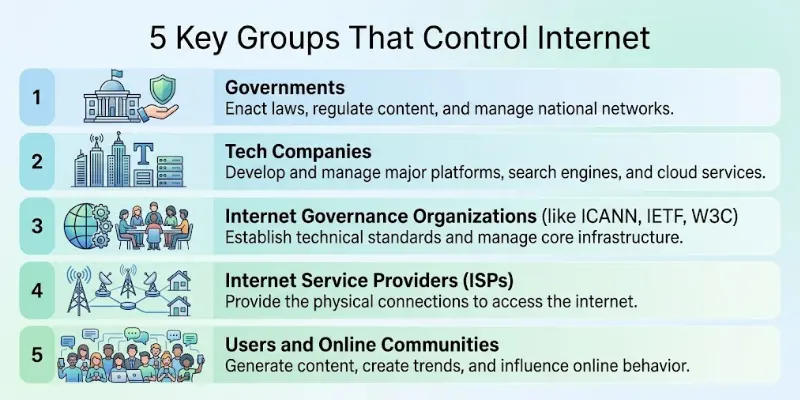
These groups do not act alone, but their decisions affect speed, access, content, and security. Each group controls a specific layer, forming a system that appears open to everyone but remains limited in function. To determine real control, it is important to look at these key players.
Below are the 5 main groups that manage the internet and influence its different layers:
- Governments
- Tech companies
- Internet governance organizations
- Internet service providers
- Users and online communities
Now let’s look at these groups in detail and see how they control different parts of the internet.
1. Government (Regulation & Censorship)
Governments play a major role in controlling how people access and use the internet. They pass laws, enforce regulations, and sometimes block websites or services. Their decisions affect millions of users every day.
Governments can influence which websites are available, how data flows, and what content is allowed online. This control varies by country. In some places, the internet is open, while in others, it is heavily monitored and restricted.
Example: China’s Great Firewall
China blocks access to many international websites like Google, Facebook, and Twitter. Local alternatives, such as Baidu and WeChat, operate under government rules.
How governments control online access:
- Set rules for online content and privacy
- Block or restrict websites and apps
- Monitor internet traffic for security purposes
- Regulate companies that provide internet services
- Influence net neutrality policies
Key Idea: Governments own the internet by making rules, monitoring activity, and deciding which parts of it people can access.
2. Tech Giants (Google, Meta, Amazon)
Tech companies control large parts of the internet through their platforms and services. They manage search engines, social media, cloud servers, and apps. These companies decide what content users see and how information spreads.
Their decisions influence communication, business, and even public opinion. While they do not own the internet, their reach gives them strong control over online experiences.
Example: Google Search
Google decides the order of search results and what websites appear for certain topics. Its ranking affects which information people find first.
How tech companies influence the internet:
- Operate platforms used by billions of people
- Manage algorithms that decide content visibility
- Control data storage and cloud services
- Decide rules for content moderation
- Influence advertising and online commerce
Key Idea: Tech companies run the internet by shaping access to content, managing platforms, and handling vast amounts of user data.
3. Internet Governance Organizations
Internet governance organizations do not own the internet, but they manage the systems that make it run. They set rules for domain names, protocols, and technical standards.
These organizations work globally to ensure that websites and networks can connect across countries. They are essential for keeping the internet stable and organized.
Example: ICANN
ICANN manages domain names like .com, .org, and .net. Without these rules, websites could not have unique addresses.
How internet organizations manage global networks:
- Manage domain names and IP addresses
- Set technical standards and protocols
- Coordinate global network systems
- Resolve disputes over internet resources
- Support secure and stable internet operations
Key Idea: Internet governance organizations shape the internet by creating rules, maintaining systems, and ensuring networks work globally.
4. Internet Service Providers (ISPs)
Internet service providers connect people to the internet and manage the flow of data. They decide the speed, stability, and sometimes the access users get. ISPs can shape the user experience by prioritizing certain services or limiting others. Their influence affects daily browsing, streaming, and online communication. While ISPs do not create content, their control over access gives them a crucial role in the online world.
Example: Internet throttling during high traffic
Some ISPs slow down streaming services or downloads during peak hours. This affects how smoothly people can watch videos or play online games.
Main ways ISPs shape the internet:
- Provide internet access to homes, businesses, and mobile users
- Decide connection speeds and bandwidth allocation
- Block or restrict access to certain websites in some regions
- Monitor data flow for security and policy compliance
- Implement local regulations and government orders
Key Idea: ISPs influence the internet by managing access, connection speed, and which services users can reach.
5. Users & Communities
Users and online communities also shape the internet, often in ways people do not notice. They create content, share information, and influence trends. Communities decide which voices get attention and how information spreads.
Their collective actions can promote ideas, push changes, or challenge control by other groups. While they cannot control infrastructure, their impact on content and engagement gives them real influence.
Example: Viral trends and movements
A hashtag or video can go viral within hours, affecting millions of people worldwide and sometimes influencing major decisions or media coverage.
How users and communities influence the internet:
- Share and promote content on social media and forums
- Influence trends, news, and public opinion
- Participate in open-source projects and software development
- Report or flag harmful content to platforms
- Create networks and communities that drive online behavior
Key Idea: Users and communities regulate the internet by shaping content, trends, and collective behavior, making the online world responsive to public action.
The Role of Net Neutrality in Internet Control
Net neutrality is the principle that all internet traffic should be treated equally. It means internet service providers (ISPs) cannot favor certain websites, apps, or services over others. Without net neutrality, ISPs can slow down some content, block websites, or charge extra fees for faster access.
This rule plays a major role in how open and fair the internet remains. In 2026, many countries are still debating net neutrality, as it affects businesses, content creators, and everyday users. Strong net neutrality ensures the internet stays free and accessible for everyone.
How net neutrality affects internet control:
- Equal Treatment: ISPs must treat all websites and apps equally without slowing down or blocking any
- No Paid Priority: Services or websites cannot pay for faster access, while others remain slow
- Unrestricted Access: Users can reach information freely without ISP restrictions
- Fair Competition: Prevents big companies from having unfair advantages over smaller startups
- Government Rules: Governments enforce net neutrality, and the rules vary from country to country
Why Net Neutrality Matters: Net neutrality controls how freely information flows online. When enforced, it limits the power of ISPs and keeps the internet open, fair, and accessible to everyone.
Who Owns the Internet Infrastructure?
The internet looks like a single system, but it runs on a large network built over many years. Different groups invest money, build systems, and keep everything running behind the scenes. No central owner controls all of it.
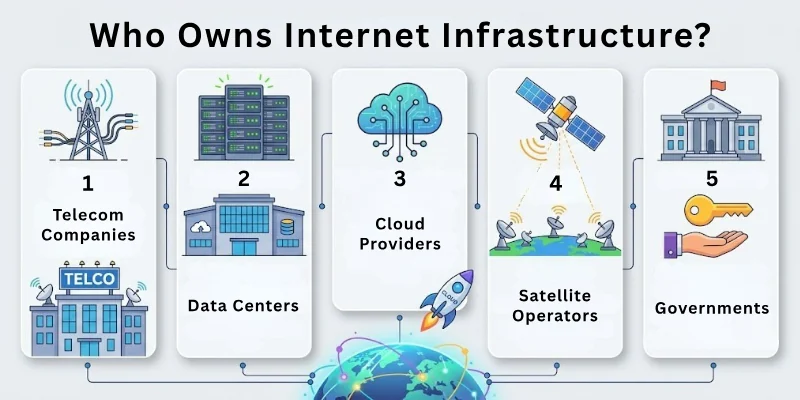
Instead, control spreads across different parts of the network, depending on who builds and maintains them. This shared ownership affects how the internet grows and how stable it remains. This explains why no single group directs the internet.
Key parts of internet infrastructure ownership:
- Telecom Companies: Own and manage physical cables, fiber networks, and undersea connections
- Data Centers: Provide storage and processing power for websites, apps, and online services
- Cloud Providers: Host services and store data for millions of businesses and users
- Satellite Operators: Enable internet access in remote areas and provide global connectivity
- Governments: Own or regulate critical networks, especially for security and public services
How Ownership Affects the Internet
Ownership affects how reliable the internet feels in daily use. Some regions get fast connections, while others face slow speeds or outages. Investment decisions decide where new technology reaches first.
Large companies often focus on profitable areas, which creates gaps in access. Ownership also affects how quickly issues get fixed and services improve.
The Myth vs Reality of Internet Control
Many people believe the internet runs without any real control. It feels open and free, which creates this idea. Different systems and decisions affect how the internet works every day. Many changes happen quietly.
The internet keeps evolving as new technologies and systems come into place. This makes it harder to see how control works over time. To know how the internet really works, we need to separate myths from facts.
Myth 1: The internet has no authority or control at all.
Reality: Control does not sit in one place, but different groups still influence how the internet works. Their decisions affect access, content, and overall experience.
Myth 2: All websites and content stay available to everyone.
Reality: Access can change based on location. Some content or services may not remain available in every region.
Myth 3: The internet works the same for everyone.
Reality: Speed, access, and content can vary from place to place. Not everyone experiences the internet in the same way.
Myth 4: No limits exist on what people can see or do online.
Reality: Restrictions can exist in different forms. Certain websites, apps, or content may face limits based on rules or policies.
Myth 5: The internet always stays active and cannot be stopped.
Reality: Some parts of the internet can become unavailable when conditions change. Access may not remain the same everywhere.
The Hidden Layer of Control
Most people see the internet as open and free, but there is a hidden layer that quietly shapes how it works. This layer includes technical systems, rules, and agreements that operate in the background. It is invisible to everyday users but affects speed, accessibility, and the flow of information.
Organizations, companies, and governments in this layer decide how data moves, which systems stay connected, and how networks follow rules. Even small changes here can affect the entire internet.
How unseen systems guide the internet:
- Routing and Traffic Management: Determines how data travels between networks and which paths are faster
- Domain and IP Management: Ensures websites have unique addresses and can connect globally
- Protocols and Standards: Decide how devices communicate and exchange information
- Security Systems: Protect networks, but also filter traffic or block certain content
- Agreements Between Providers: Influence peering, data exchange, and international connectivity
Impact of the hidden layer: This hidden layer affects what users see and how quickly they access it. While invisible, it gives significant control to those who manage networks and technical rules.
Who Governs the Internet in Different Countries?
The internet does not work the same way in every country. Each country follows its own approach based on laws, policies, and national priorities. Some countries allow open access to most websites and services, while others apply strict limits.
These differences affect what people can access, share, and experience online. In 2026, the gap between open and restricted internet systems has become more visible.
Real-World Examples:
- Open Access: United States, Canada, Germany, and the Netherlands allow broad access to global platforms. These countries also have strong laws that support free access to information.
- Restricted Access: China, Iran, North Korea, and Russia enforce strict control over the internet. Many global platforms remain blocked, and governments monitor online activity.
- Mixed Approach: India, Turkey, Pakistan, and the United Arab Emirates allow general access but restrict certain content. These limits often appear during protests or elections.
- Temporary Restrictions: Ethiopia, Myanmar, and Sri Lanka have blocked internet access during political unrest or security concerns. These shutdowns can last from hours to several days.
- Strong Data Control: China and Russia focus on keeping user data within national borders. They enforce strict rules on how companies store and manage data.
- Platform-Specific Bans: Some countries block specific apps or platforms. For example, TikTok has faced bans or restrictions in countries like India and Afghanistan due to security concerns.
Can Governments Shut Down the Internet?
Governments have the power to limit or completely shut down internet access in their countries. They can order internet service providers to block connections, disable mobile data, or stop access to certain networks. These shutdowns usually happen during political unrest, elections, or national emergencies.
While rare in fully open countries, temporary outages have become more common worldwide. In 2025, over 50 countries reported at least one major internet shutdown. These actions can disrupt businesses, communication, education, and access to news.
Here are the main ways governments block internet access:
- Partial Shutdowns: Block specific apps, websites, or social media platforms
- Full Shutdowns: Stop internet access entirely for all users in a region
- Throttling or Slowdowns: Reduce connection speed to make online services difficult to use
- Targeted Restrictions: Limit access for certain groups, cities, or networks
- Emergency Orders: Suspend access during protests, elections, or security threats
Wrap-Up
Dear readers, we explored who controls the internet in detail. We looked at the main groups that influence it, including net neutrality, internet infrastructure ownership, the hidden layers of control, and real-world examples from different countries.
Through myths and realities, we learned that the internet is not as free and open as it seems. Decisions made behind the scenes affect speed, access, and content. Overall, internet control is a complex, multi-layered system. No single authority owns it, but the decisions of different players directly affect our everyday internet use.
At the end of this blog, you will also find FAQs. Be sure to read them.
FAQs
The following are quick answers to the most common questions about who controls the internet.
Internet governance refers to the rules, processes, and agreements that guide how the internet operates. It includes how domain names are managed, how networks connect, and how technical standards are set. Multiple groups, including governments, companies, and international organizations, help shape these rules.
AI systems influence what content users see and which information spreads. Social media, search engines, and recommendation platforms rely on algorithms. These tools indirectly control access to news, entertainment, and commerce. AI adds a new layer to internet governance.
Yes, access control varies based on location. Urban areas often have faster connections and more platform availability. Rural regions may face slow speeds, fewer services, or restrictions. Physical infrastructure and investment decisions create these differences.
Yes, international bodies like ICANN and the Internet Society create rules to keep the internet stable. They coordinate domain names, IP addresses, and technical standards. These rules prevent control by any single country or company. They act as a balancing force in global internet governance.
Yes, internet governance and control are increasing globally. Countries are introducing stronger data privacy laws, cybersecurity rules, and content regulations. Tech platforms continue to increase their influence over online services, while AI adds new layers of control. The future will likely balance open access with structured regulation.
Cybersecurity incidents can influence online access control.
- Governments and companies tighten security after attacks.
- Certain websites or services may experience temporary restrictions.
- Security rules indirectly determine network access and service availability.
Yes, smaller nations can impact global internet governance. They may require local data storage, regulate foreign platforms, or block certain apps. These rules affect global companies operating in their regions. Actions by small countries can influence internet policies worldwide.
Content filters determine what users can see online.
- Schools, workplaces, and governments often set filters to manage online access.
- Filters block harmful, illegal, or restricted content.
- They influence which platforms and websites remain visible to different users.
Global laws and agreements influence internet governance and online access control. Rules like Europe’s GDPR limit how companies store and manage data. Countries may enforce or ignore these rules depending on national priorities. These regulations shape which services remain available worldwide.
Yes, big tech companies influence what people see online through algorithms and content policies. Search engines and social platforms decide which content appears first and what gets removed or limited. While they do not control the entire internet, they strongly shape online visibility and information flow.

- Be Respectful
- Stay Relevant
- Stay Positive
- True Feedback
- Encourage Discussion
- Avoid Spamming
- No Fake News
- Don't Copy-Paste
- No Personal Attacks
- Be Respectful
- Stay Relevant
- Stay Positive
- True Feedback
- Encourage Discussion
- Avoid Spamming
- No Fake News
- Don't Copy-Paste
- No Personal Attacks
