ISPs in Kenya: Providers & Comparison Guide
Published: 25 May 2026
Over 5.19 billion GB of data was used in Kenya alone in 2025. Besides this, many still struggle to find stable connections in 2026, while others pay more but get less speed. There is a big gap between what companies promise and what we actually get.
I will give you a comprehensive overview of ISPs in Kenya, their key differences, honest insights, and clear guidance on how they differ in speed, pricing, and coverage. You will also see how different providers perform during peak hours and in different locations, not just in ads or claims.
Let’s start with the top internet providers in Kenya.
List of ISPs in Kenya
Kenya has many internet providers that offer different types of connections. However, the quality of service varies in terms of speed, coverage, and other features. Below is a list of the main ISPs’ options available.
1. National Fiber ISPs
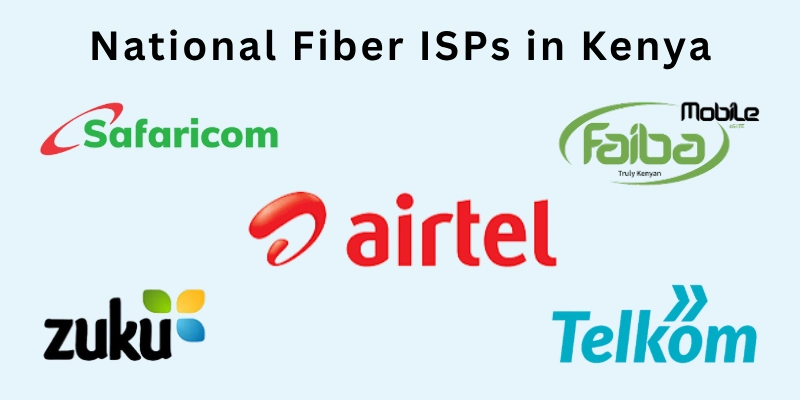
- Safaricom
- Zuku
- Faiba
- Airtel Kenya
- Telkom Kenya
2. Satellite Internet Providers
- Starlink
- SEACOM Kenya
- iWayAfrica Kenya
- Intersat Africa
- Orbital Africa Networks
3. Fixed Wireless & Broadband ISPs
- Poa Internet
- Mawingu Networks
- Vilcom Networks
- Wavex Internet
- AccessKenya
- Frontier Optical Networks
- SimbaNET Kenya
4. Enterprise & Corporate ISPs
- Kenya Data Networks
- Liquid Intelligent Technologies
- Internet Solutions Kenya
- Host Africa
- Cloud Africa Networks
- Dimension Data Solutions East Africa
- Soliton Telmec
- Interconnect Ltd
5. Local & Regional ISPs
- Ahadi Wireless
- Volo Internet Solutions
- TunapandaNET
- Flashcom Africa
- East Africa Data Handlers
- MyISP Limited
- Syokinet Solutions
Details of each ISP are explained individually.
National Fiber ISPs
National fiber ISPs provide high-speed internet via fiber-optic networks in major towns and cities across Kenya. They are known for stable connections, higher speeds, and better performance compared to most wireless options.
Here are the main national fiber ISPs operating in Kenya.
1. Safaricom
Safaricom Home Fibre is one of the most used internet services in Kenya. It provides internet through fiber cables that deliver stable and fast connections for homes and offices.
- High-speed fiber connection with low downtime
- WiFi router provided during installation
- Multiple device connections at the same time
- 24/7 network monitoring system
- Easy top-up through mobile money
Coverage Area
Safaricom Home Fibre works in major towns and many residential estates in Kenya. Availability depends on fiber line installation in your specific area.
Pricing and Plans
Safaricom offers different monthly packages:
- 10 Mbps – around KSh 2,999 per month
- 20 Mbps – around KSh 4,000 per month
- 40 Mbps – around KSh 6,299 per month
- 100 Mbps – around KSh 12,499 per month
Benefits of Safaricom
- Stable connection for daily use
- Fast installation in covered areas
- Good performance for streaming and online work
- Strong mobile integration for payments
Limitations of Safaricom
- Installation is not available in all locations
- Prices feel high for some users
- Speed drops during peak usage hours in some areas
2. Zuku
Zuku Internet offers fiber- and cable-based internet services mainly in urban areas. It is known for bundle packages that combine internet and TV services.
- Combined internet and TV packages
- Unlimited data on most plans
- Home router included in setup
- Simple monthly subscription system
- Fixed-speed packages for different users
Coverage Area
Zuku mainly operates in major cities, including Nairobi, Mombasa, Kisumu, and Nakuru. Availability depends on network rollout in residential areas.
Pricing and Plans
Zuku offers monthly unlimited plans:
- 10 Mbps – around KSh 2,799
- 20 Mbps – around KSh 3,999
- 60 Mbps – around KSh 5,999
- 100 Mbps – around KSh 6,999
Benefits of Zuku
- Unlimited internet on most plans
- Affordable bundle options
- Good for home entertainment use
- Simple billing system
Limitations of Zuku
- Slower customer response in some cases
- Installation delays in new areas
- Speed consistency varies in busy hours
3. Faiba
Faiba Internet is offered by Jamii Telecommunications and is known for strong speed performance at competitive prices.
- High-speed fiber internet service
- Supports heavy data usage
- Strong performance for streaming and gaming
- Simple prepaid and postpaid options
Coverage Area
Faiba operates mainly in selected urban areas in Kenya. It focuses on cities where fiber infrastructure is already installed.
Pricing and Plans
Faiba offers high-speed monthly packages:
- 30 Mbps – around KSh 3,000
- 50 Mbps – around KSh 4,000
- 100 Mbps – around KSh 5,000
- 250 Mbps – around KSh 10,000
Benefits of Faiba
- Very fast speeds for heavy use
- Strong performance for downloads and streaming
- Stable connection in covered areas
Limitations of Faiba
- Limited availability in many regions
- Installation depends on fiber coverage
- Service expansion is still slow in new locations
4. Airtel Kenya
Airtel Kenya provides fiber and mobile internet services in many urban areas. It focuses on affordable internet plans for homes and small offices.
- Fiber and mobile internet options
- Data bundles that work on multiple devices
- Home router setup for fiber users
- Simple mobile app for account control
- Prepaid and postpaid plans
Coverage Area
Airtel Kenya operates in major towns like Nairobi, Mombasa, Kisumu, and Eldoret. Fiber service depends on the availability of installation in your estate.
Pricing and Plans
Airtel offers flexible internet bundles:
- 10 Mbps – around KSh 2,500 per month
- 20 Mbps – around KSh 3,500 per month
- 50 Mbps – around KSh 5,000 per month
- Mobile bundles – starting from KSh 50 daily packs
Benefits of Airtel Kenya
- Low-cost internet plans
- Easy mobile recharge system
- Good for everyday internet use
- Quick setup for mobile data users
Limitations of Airtel Kenya
- Fiber service is not widely available
- Speed drops in crowded network areas
- Limited high-speed options compared to top fiber providers
5. Telkom Kenya
Telkom Kenya offers internet services through fiber, mobile data, and wireless connections. It serves both home users and businesses with various internet packages.
- Fiber, 4G, and wireless internet services
- Data bundles for home and mobile use
- Router installation for fixed internet
- Prepaid internet options are offered
- Data rollover on selected plans
Coverage Area
Telkom Kenya works in selected towns and cities across Kenya. Fiber coverage is still expanding in residential estates and business zones.
Plans and Pricing
Telkom provides mixed internet packages:
- 10 Mbps – around KSh 2,800 per month
- 20 Mbps – around KSh 3,800 per month
- 50 Mbps – around KSh 5,500 per month
- Mobile bundles – starting from KSh 100 per week
Benefits of Telcom Kenya
- Flexible internet options for different users
- Data rollover on some packages
- Good mobile internet availability
- Affordable entry-level plans
Limitations of Telcom Kenya
- Fiber coverage is limited in many areas
- Network speed changes during peak hours
- Customer response time varies in some regions
Satellite Internet Providers
Internet from satellites works through signals sent from space to a dish installed at your location. It does not depend on underground cables or mobile towers. This makes it useful in locations with weak network coverage.

These are the satellite internet providers:
- Starlink: Uses a network of low-orbit satellites to deliver internet directly. It is designed for fast connection and works even in remote locations where other services are weak.
- SEACOM Kenya: Provides satellite-based and submarine cable internet solutions. It focuses on linking companies with global networks for data transfer and communication.
- iWayAfrica Kenya: Delivers satellite internet for businesses, NGOs, and remote operations. It is often used in places where wired internet is unavailable or is unstable.
- Intersat Africa: Offers satellite connectivity for corporate users and field operations. It supports communication needs in areas with limited facilities.
- Orbital Africa Networks: Provides satellite internet services for enterprise and institutional use. It focuses on connectivity solutions for remote sites and special projects.
Fixed Wireless & Broadband ISPs
Fixed wireless and broadband ISPs use wireless signals or tower-based systems for internet access. This type of connection is common in areas where fiber lines have not yet reached.
The following are the broadband providers in Kenya:
- Poa Internet: Runs on fixed wireless towers that bring home internet without fiber cables. It focuses on unlimited access in residential areas.
- Mawingu Networks: Connects rural and semi-urban locations through wireless signals. It reaches places where physical internet lines are not installed.
- Vilcom Networks: Works through fixed wireless stations that send the internet directly to homes and small offices. It mainly covers selected towns and nearby estates.
- Wavex Internet: Uses wireless infrastructure to bring the internet to households in specific regions. Its service area includes limited urban zones.
- AccessKenya: Handles internet connections for corporate users and business environments. It focuses on data links and managed network systems for organizations.
- Frontier Optical Networks: Offers hybrid connectivity using wireless and fiber routes. It mainly serves institutions that depend on continuous data transmission.
- SimbaNET Kenya: Connects business clients with local and international data routes. It operates mainly in the enterprise and corporate sector.
Enterprise & Corporate ISPs
Enterprise and corporate ISPs focus on large organizations that need strong data connections. They mainly serve companies, institutions, and service-based businesses. These providers deliver more advanced internet solutions.
Kenya’s main enterprise and corporate ISPs are:
- Kenya Data Networks: Builds data connections for businesses. It mainly supports large-scale organizational operations.
- Liquid Intelligent Technologies: Connects businesses to local and international networks through fiber. It works for large corporate clients and service providers.
- Internet Solutions Kenya: Works with companies to manage internet and cloud-based network systems. It supports business communication and data hosting needs.
- Host Africa: Provides hosting services, cloud systems, and internet solutions for businesses and developers. It has a digital system for online services.
- Cloud Africa Networks: Builds cloud-based and network services for organizations that rely on online systems. It possesses data storage and connectivity solutions.
- Dimension Data Solutions East Africa: Works with enterprises on IT, networking, and managed services. It helps organizations that manage large computer networks.
- Soliton Telmec: Builds telecom and network systems for enterprises. It works on large communication and engineering projects.
- Interconnect Ltd: Provides network connectivity solutions for businesses and institutions. It allows data exchange and communication systems for organizations.
Local & Regional ISPs
Local and regional internet providers target towns, estates, and nearby communities. They build smaller networks that bring the internet closer to areas where major providers do not fully cover. These fulfill basic connectivity needs.
The list below shows providers serving enterprise and corporate users in Kenya:
- Ahadi Wireless: Runs wireless internet networks for local communities and small businesses. It connects users in selected areas with limited access to fiber services.
- Volo Internet Solutions: Provides reliable internet services to residential estates and surrounding urban communities through its fixed wireless network.
- TunapandaNET: Builds community-based internet networks for learning spaces and local users in underserved areas.
- Flashcom Africa: Offers wireless internet services tailored for residential customers and small businesses, particularly in towns with fixed network coverage.
- East Africa Data Handlers: works with local clients on internet access, data connectivity, and small-scale network requirements.
- MyISP Limited: Provides internet services in local regions for homes and offices.
- Syokinet Solutions: Delivers wireless internet to estates or nearby communities and serves users in selected coverage zones.
How Internet Services Work in Kenya
Internet connectivity in Kenya relies on several systems, including fiber-optic cables, wireless towers, mobile networks, and satellite links. Every provider uses a different method to deliver data. The connection type we get depends on our location and the provider’s setup in that area.
Here is the breakdown of the basic steps:
- Data travel: Internet data moves from service providers through cables, towers, or satellites before reaching your device. This movement occurs in small packets that carry information back and forth.
- Network connection: Your device connects to a nearby tower, fiber line, or satellite dish. This link allows your phone or computer to access online content.
- Service routing: Providers send your request through their network systems to reach websites or apps. The system finds the best available path for the data.
- Signal delivery: The final internet signal reaches your home router or mobile device. This step allows you to use the internet for different online activities.
Comparison Table of Internet Providers in Kenya
Kenya has many internet providers with different service levels. The table below compares the main ISPs in a simple format. It shows their key details for easy understanding.
| ISP | Connection Type | Monthly Cost | Setup Time | Stability Level |
| Safaricom | Fiber | KSh 2,999–12,499 | 1–3 days | High |
| Zuku | Fiber/Cable | KSh 2,799–6,999 | 2–5 days | Medium to High |
| Faiba | Fiber | KSh 3,000–10,000 | 2–4 days | High |
| Airtel Kenya | Fiber/Mobile | KSh 2,500–5,000 | 1–3 days | Medium |
| Telkom Kenya | Fiber/Mobile | KSh 2,800–5,500 | 2–6 days | Medium |
| Poa Internet | Wireless | KSh 1,500–2,500 | 1–2 days | Medium |
| Mawingu Networks | Wireless | KSh 2,000–4,000 | 2–7 days | Medium |
| Starlink | Satellite | KSh 6,500–12,000 | 3–7 days | High |
Best Kenya ISPs for Different Needs
Different internet providers in Kenya are designed for different requirements. Some specialize in home internet, others support business use, and some work in areas with limited networks. The right choice depends on speed, location, and how the connection is used.
A simple guide based on different internet needs:
- For wide nationwide fiber coverage and strong telecom services: Safaricom
- For home internet with TV bundles: Zuku
- For mobile and home internet together: Airtel Kenya
- For low-cost internet access in many estates: Poa Internet
- For high-speed fiber internet in selected towns: Faiba
- For business-grade internet and international data links: Liquid Intelligent Technologies
- For simple wireless internet without bundled services: Mawingu Networks
- For satellite internet in remote locations: Starlink
- For enterprise networking and IT solutions: Internet Solutions Kenya
- For small office and residential wireless access: Vilcom Networks
- For data hosting and cloud-based services: Host Africa
- For rural community internet access: TunapandaNET
How to Choose the Best ISP in Kenya
Not all internet companies in Kenya give the same experience, even if the plans look similar. The quality of connection can vary between different providers. Before selecting any ISP, it is important to keep a few essential factors in mind:
- Coverage area: Check whether the ISP has strong network availability in your location, as internet quality in Kenya can vary across different areas.
- Speed performance: Compare actual internet speed, not just advertised numbers.
- Connection type: Consider whether the ISP uses fiber, wireless, mobile data, or satellite, as each one gives a different level of performance and reach.
- Data policy: Check whether the internet plan has data limits or fair usage policies that may reduce speeds after heavy use.
- Cost structure: Evaluate monthly charges with the speed and service quality to see what you actually get for the price.
- Reliability: Analyze how the network stays active without interruption, especially during busy hours or bad weather conditions.
- Customer response: See how quickly the provider fixes issues when the connection goes down or slows.
- Local feedback: Ask people in your area about their experience.
Government Role in Kenya’s Internet Services
The government has a major part in how internet services grow and operate in Kenya. It sets rules that guide providers and ensure fair use of communication systems. It also invests in national projects that expand internet access to more areas.
These efforts help improve connection quality and reach more users.
- Regulation: The Communications Authority of Kenya sets rules for internet providers and ensures they follow licensing requirements.
- Licensing: The government issues permits to companies that want to offer internet services, which controls who can operate in the market.
- Infrastructure projects: Public initiatives like the National Optic Fiber Backbone Infrastructure expand fiber networks to towns and rural areas.
- Market supervision: Authorities monitor providers to maintain fair competition and prevent misuse of network services.
- Public access programs: The government supports digital centers and community networks to increase internet access in underserved regions.
- Policy development: National policies guide how internet services can grow, including plans for the digital economy and connectivity.
Common ISP Problems in Kenya
Internet speed in Kenya is generally good, but it can cause issues. Even with strong infrastructure, no system stays perfect all the time. Some usual ISP problems that are still common in Kenya:
- Drop in speed: Internet speed may fall when numerous devices go online at once, especially in the evening.
- Network overload: High usage in certain locations can put pressure on local networks and affect performance.
- Temporary service loss: The internet may slow down for a short time due to maintenance, technical faults, or system updates.
- Weak WiFi signals: Signal strength can drop inside buildings because of wall barriers, router placement, or interference.
- Router problems: Old or faulty devices can reduce speed and create unstable connections.
- Uneven network coverage: Some areas receive strong signals while others may have weaker or unstable connections.
Conclusion
We have covered ISPs in Kenya and explored different types of internet providers, including fiber, wireless, satellite, and enterprise services. It also included how they work, common problems, and how to select the best option.
Every internet provider has some advantages and disadvantages, so it is better to compare carefully and manage risks by matching the service with your actual usage and coverage area. I hope this guide helped you understand the various types of ISPs and their comparisons.
Let’s find out the FAQs below.
Frequently Asked Questions
This section explains important questions about ISPs in Kenya.
Internet use in Kenya depends on the ISP because each provider offers different speeds and coverage. Some ISPs perform better in cities, while others work well in rural areas. The right ISP also improves internet quality.
Internet access in Kenya depends on network availability, infrastructure, and location. Areas with strong fiber or mobile towers get better connectivity. Remote regions may rely on wireless or satellite services. The ISP you choose also plays a major role in access quality.
Fiber ISPs are often used for home internet because they give stable speeds. Wireless options also work in areas without fiber lines. The best choice depends on coverage in your location. Always check availability before selecting a provider.
- Fiber ISPs use cables to deliver the internet, which gives stable performance. It is usually faster in cities.
- Wireless ISPs use radio signals from towers instead of cables. It works better in spread-out areas.
Both depend on infrastructure availability.
ISP coverage can be checked through provider websites or customer support. Many companies show maps of active service areas. You can also ask neighbors about their connection experience. Testing availability in your exact location is important.
ISPs improve services by expanding networks and upgrading infrastructure. They install fiber lines, towers, and satellite systems to increase reach. These improvements help more areas get connected. Over time, this increases overall connectivity across the country.
The cost of the internet in Kenya affects the speed and quality of service users receive. Higher-priced plans often provide faster speeds and better stability, while lower-cost options may have limited performance or coverage. It is important to balance price with actual internet needs.
Most ISPs require a router to distribute internet access within homes or offices. Some services also require fiber-optic cables or wireless receivers, while satellite internet typically needs a dish installation. The required equipment depends on the type of ISP and connection being used.
Some ISPs offer unlimited internet packages, especially for home and business users. Others apply data limit policies. In some plans, internet speeds may be reduced after a certain level of usage. Availability depends on the provider and the selected package.
Not all ISPs cover the entire country. Some focus only on cities, while others target rural areas. Satellite ISPs cover wider regions compared to fiber providers. Availability depends on infrastructure and investment.




- Be Respectful
- Stay Relevant
- Stay Positive
- True Feedback
- Encourage Discussion
- Avoid Spamming
- No Fake News
- Don't Copy-Paste
- No Personal Attacks
- Be Respectful
- Stay Relevant
- Stay Positive
- True Feedback
- Encourage Discussion
- Avoid Spamming
- No Fake News
- Don't Copy-Paste
- No Personal Attacks
