90+ Amazing Facts About the Internet That Will Shock and Entertain You
Published: 3 May 2026
When I first tracked internet growth, only a few billion people were online. Today, about 6 billion people, nearly three-quarters of the world, use the internet every day for work, study, and play. That alone makes the web one of the fastest-growing technologies in history, and I still find the numbers mind-blowing as they climb year after year.
I will share the amazing facts about the internet that will surprise you, make you think, and maybe even change how you use it every day. You will find hidden secrets behind the websites, apps, and services we take for granted, plus many fun, statistical, historical, and record-breaking facts about the internet.
You won’t believe how much the internet has grown. Let’s find out more.
Amazing Internet Facts
The internet is now part of almost everyone’s life. Even though we use it every day, most of us don’t realize how much it has grown and changed. It connects people from all over the world in seconds and makes many things possible that were once impossible.
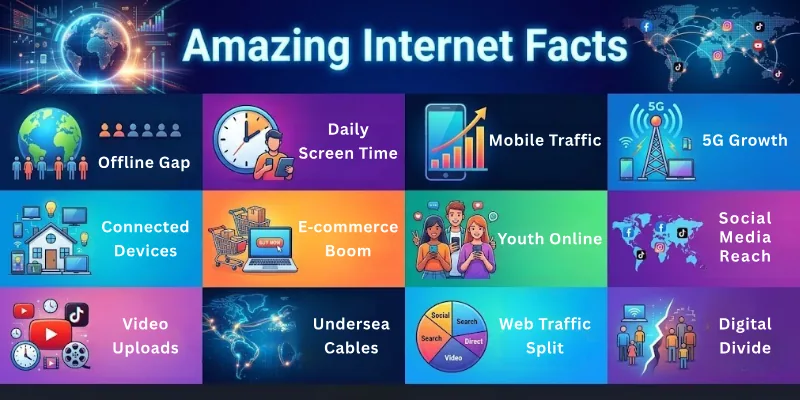
The more we explore it, the more we understand how powerful and important it has become. Learning about internet facts helps you see how it can bring positive changes to your life and daily tasks.
Here are some interesting facts about the internet:
- Offline Gap: Around 2.2–3 billion people still don’t have internet access due to cost or infrastructure.
- Daily Screen Time: People spend 6–7 hours online daily, with younger adults often spending more.
- Mobile Traffic: Over 59% of internet traffic comes from mobile phones.
- 5G Growth: 5G networks now cover more than half the world’s population.
- Connected Devices: About 21 billion IoT devices exist in 2025 and are expected to reach 39 billion by 2030.
- E‑commerce Boom: Global online shopping reached $6.4 trillion in 2025.
- Youth Online: People aged 18–34 make up over 40% of internet users.
- Social Media Reach: There are 5.2–5.6 billion social media user accounts worldwide.
- Video Uploads: YouTube sees hundreds of hours of video uploaded every minute.
- Undersea Cables: Fiber-optic cables carry about 95% of global internet traffic.
- Web Traffic Split: Around 52% of all web traffic comes from mobile devices.
- E‑commerce Mobile Share: 72% of online shopping comes from mobile devices.
- Digital Divide: High-income regions have over 90% internet access, while lower-income areas lag.
Fun Facts About the Internet
The internet is full of surprises, and not everything we see online tells the whole story. Behind every website, video, or message, there are fascinating facts that most people don’t know. From its history to the amazing technology that keeps it running, the internet has grown faster than anyone could have imagined.
Discover some exciting and fun facts about the internet:
- Oldest Message: The first message sent over a network in 1969 was just “LO”; they were trying to type “LOGIN.”
- First Email: Ray Tomlinson sent the first email in 1971 and used “@” to separate the user from the computer.
- First Website: Tim Berners‑Lee created the first website, which still exists today.
- Deep Web Size: Most online content is on the Deep Web and isn’t indexed by search engines.
- Emails Sent Daily: Hundreds of billions of emails are sent worldwide every day.
- Internet Speed Record: The fastest recorded internet speed reached 319 terabits per second.
- More Devices than People: There are more internet-connected devices than humans on Earth.
- Data Creation Explosion: About 90% of all data was created in the last few years.
- The Internet’s Name: The Internet comes from “interconnected networks.”
- Before the Web: Email and other internet tools existed before the World Wide Web in 1989.
- Constant Growth: New websites and services appear every day, and information keeps increasing.
- Google Searches: Google processes billions of searches daily, making it the most used search engine.
Record-Breaking Facts About the Internet
The internet does not just grow; it also keeps breaking records that show how far digital technology has come. Researchers and engineers around the world constantly push the limits of speed, scale, and connectivity. These record-breaking feats mark milestones in science and help shape the future of how we use the web every day.
Let’s look at some of the most impressive internet records ever set:
- Fastest Internet Speed: Scientists in Japan reached 1.02 petabits per second, far faster than normal connections.
- Speed Comparison: This is 3.5 million times faster than the average internet in the United States.
- Previous Milestone: Researchers earlier achieved 402 terabits per second, showing steady progress.
- Optical Fiber Innovation: Advanced 19-core fiber cables carry massive amounts of data at once.
- Longest Distance Test: Record speeds were measured over 1,800 kilometers without losing strength.
- Commercial Breakthroughs: Some countries now offer 10-gigabit broadband networks, much faster than older standards.
- Mass Data Growth: Telecom data usage in some countries has reached record-high yearly totals.
Historical Facts About the Internet
The internet started as a way for scientists to share information quickly. It grew step by step into the global network we use every day. Being familiar with these milestones helps us see how technology connects the world and changes lives.
By looking at the key events in its development, we can appreciate the progress and innovation behind the internet.
- Early Concept (1960s): Scientists tried to connect computers to share information over long distances.
- ARPANET Launched (1969): ARPANET, the first network using packet switching, laid the foundation for the Internet.
- First Network Message (1969): UCLA sent the first message to Stanford; only “LO” went through before a crash.
- TCP/IP Adopted (1983): Networks started using TCP/IP, which became the main system for data exchange.
- World Wide Web Created (1991): Tim Berners-Lee built the Web to make information easy to access and share.
- Web Growth (1990s): Websites grew from a few to thousands within a few years after the web went public.
- Internet Cafés Start (1994): The first public internet cafés opened for people outside homes and offices.
Weird Facts About the Internet
The internet can be strange in ways that we mostly never notice. Some parts of the web seem pointless or silly, while others look like they belong to a different world entirely. Weird things happen online every day, from unusual sites to strange patterns in traffic and content.
These weird facts may seem humorous or odd, but they also show the internet’s unpredictable character:
- Strange Classic Website: Zombo.com welcomes you with audio but gives no content or tools.
- Internet Bots Everywhere: Many websites run automated programs called bots that make up a large part of the activity.
- Dead Internet Idea: Some believe most online content may soon be created by machines, not humans.
- Internet Traffic Sounds Weird: Projects make modern Wi‑Fi “scream” like old dial-up modems.
- Backpack Robot That Stares: Mirumi, a small robot, attaches to a backpack and stares at people.
- Houseplants Can Affect Wi‑Fi: Plants near routers may slightly change signal strength.
- Domain Betting Gone Wrong: Someone tried to sell Lambo.com for $75 million and lost in court.
- Minecraft on a Lightbulb: A hobbyist ran a Minecraft server on a tiny smart lightbulb.
- Click Tracking Site: ClickClickClick records every mouse movement and speaks it aloud.
- Eel Slap Website: Eel Slap slaps a character with a virtual eel when you move the cursor.
Cute Random Facts About the Internet
The internet isn’t just big and fast; it can be funny, adorable, and full of surprises. Some odd little facts make us smile or shake our heads at how quirky the web can be.
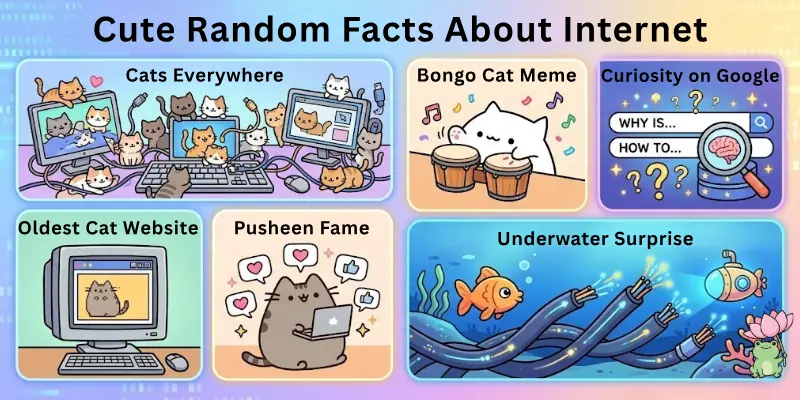
Here are some random facts that show the internet’s playful side:
- Cats Everywhere: Cats are the unofficial mascots of the internet, with millions of images and videos shared daily.
- Oldest Cat Website: sophie.net has been running cat content since 1999.
- Pusheen Fame: The cartoon cat Pusheen has millions of fans worldwide through stickers and memes.
- Bongo Cat Meme: A cat “playing” instruments became a viral meme with countless song edits.
- Curiosity on Google: Typing “I’m feeling curious” gives random fun facts instantly.
- Smart Oddities: There are internet-connected jeans, mirrors, and cutlery that track activity or show data.
- Underwater Surprise: Sharks sometimes bite undersea cables, briefly affecting internet signals.
Internet Statistics & Usage Facts
The internet keeps growing continuously. Every day, billions of actions, searches, messages, purchases, and streams show how essential the internet has become. These patterns reveal not just how we use the internet, but also how it continues to evolve with great speed.
These facts show the scale, trends, and habits of internet users worldwide:
- Average Global Internet Speed: The average fixed broadband speed worldwide reached about 87 Mbps in 2025.
- Most Popular Websites: Google, YouTube, and Facebook continue to be the top three most visited sites globally.
- Email Usage: People send and receive about 347 billion emails daily worldwide.
- Messaging Apps: WhatsApp, Messenger, and WeChat have over 5 billion active accounts combined.
- Online Video Streaming: The average person spends over 100 minutes per day watching online videos.
- E-learning Growth: Around 350 million students worldwide use online learning platforms.
- Online Gaming Users: There are over 3 billion gamers online globally, including mobile, PC, and console.
- Cloud Usage: Over 94% of enterprises now use some form of cloud service for data and apps.
- Digital Payments: Global online payment transactions exceeded $6 trillion in 2025.
- Internet in Rural Areas: About 30% of rural populations worldwide still have limited or no internet access.
- Streaming Music: More than 500 million people use streaming music services daily.
- Remote Work: Around 28% of the global workforce works remotely at least part-time, relying heavily on internet access.
Lifestyle Facts About the Internet
From fitness apps to online shopping, the internet impacts routines and habits around the world. It affects how we work, shop, communicate, and even relax. It has become a daily habit we rely on without even thinking about it.
The following lifestyle facts show how deeply the internet is part of our everyday choices:
- Health & Fitness Apps: Millions track fitness, sleep, and diet daily through internet-connected apps and devices.
- Food Delivery: Global online food delivery orders reach hundreds of millions each day, showing convenience trends.
- Travel Planning: Most travelers research trips online, from flights to accommodations, before booking offline.
- Virtual Communities: People join forums, hobby groups, and online clubs to share interests and advice.
- Online Recipe Searches: Millions of people look up recipes online every day, changing the way we cook at home.
- Pet Care Apps: Many pet owners use apps to track their pets’ health, schedule vet visits, and even monitor activity.
- Virtual Fitness Classes: Online fitness classes and yoga sessions have millions of participants worldwide each day.
- Language Learning Online: Over 100 million people use apps and websites to learn new languages.
- Digital Hobby Communities: People join online groups for hobbies such as photography, painting, and gardening.
- Streaming Podcasts: Millions listen to podcasts daily on topics ranging from storytelling to education.
- Online Dating: More than 300 million people use dating apps or websites globally.
Security & Safety Facts About the Internet
The internet brings great convenience, but it also has real risks that affect many users every day. People all over the world face threats like scams, data theft, and harmful content if they are not careful. These security and safety facts can help you stay alert and protect yourself and your information online.
These facts show how common online risks are and why safe practices matter for everyone:
- Online Risk Experience: About 58% of people in the UK faced at least one major online risk in 2025.
- Data Breaches: In 2022, 1,863 data breaches exposed billions of records.
- Daily Data Exposure: Millions of personal records are exposed online every day.
- Phishing Danger: Many attacks come from fake emails or messages that steal information.
- Weak Passwords: People still use weak or never‑changed passwords, making accounts easy to hack.
- Public Wi‑Fi Risk: Using unprotected public Wi‑Fi can lead to stolen data.
- Human Error: Most security breaches happen because of simple mistakes.
- Privacy Concern: Many users worry about how companies share or use their data.
Rarest Facts About the Internet
Some facts are so unusual that very few people know about them. These rare facts reveal the hidden, unexpected, or quirky side of the digital world. Exploring them gives a glimpse into the unusual corners of the internet and how technology affects life in strange ways.
These are rare facts that most of us never come across in everyday use of the internet:
- Internet “Ghost Towns”: Thousands of websites exist today but are abandoned, with no updates for years, yet still online.
- Oldest Domain Still Active: Symbolics.com, registered in 1985, is the oldest active domain name in existence.
- Internet “Dust”: Vast portions of the web exist as data nobody visits, sometimes called the “data dust” of the internet.
- Tiny Websites: Some websites are less than 1 KB in size, containing only a few words or a single image.
- Unusual TLDs: The internet has rare domain extensions like .ninja, .space, .guru, and .pizza used for fun or marketing.
- Digital Artifacts: Some websites preserve early web designs from the 1990s, still viewable online.
- Invisible Internet: Some pages exist but are blocked from search engines, making them extremely hard to find.
- Internet in Space: Satellites and space stations have their own internet connections for data and communication.
- Obscure Languages Online: Thousands of websites exist in rare or extinct languages, keeping them digitally alive.
Conclusion
We explored many amazing facts about the internet, from how it started to how it works today. We looked at fun facts, weird facts, rare facts, lifestyle facts, and important statistics that show how big and powerful the internet has become. Each section shared something new, whether it was surprising, useful, or thought-provoking.
This blog gave you a complete overview of the internet, covering its history, growth, usage, and its impact on daily life. It showed that the internet is not just a tool but an important part of how we live, work, and connect with others.
Before you leave, make sure to read the FAQs section. It also includes interesting and fun knowledge.
FAQs: Amazing Facts About the Internet
I will give a simple explanation to some questions about internet facts.
The internet connects people and information from all over the world every day. It helps students learn new things, workers communicate, and businesses sell products online. Doctors and scientists also use it to share ideas and solve problems faster. Without the internet, many services we use now would stop working.
The internet began as a research network in the 1960s and 1970s, but most people could not use it then.
- In the 1990s, companies and homes started getting online.
- By the early 2000s, many households in developed countries had internet access.
- Widespread use grew even more after smartphones made it easy to go online everywhere.
As of late 2025, about 117 million people in Pakistan use the internet, which is nearly half of the population. This number shows that more people are going online for work, learning, and social media. The user count continues to grow as mobile data becomes cheaper and more accessible.
People around the world spend a lot of time online each day. On average, a person uses the internet for about 6.5 hours daily for work, videos, social media, and browsing. This daily use continues to rise as more services shift online.
Students use the internet to find books, videos, and tutorials that help with schoolwork.
- They can take online courses and join study groups from anywhere.
- Research becomes faster and easier because many libraries are online now.
- They also practice skills such as writing, coding, and language use with web tools.
The internet has changed how people live, work, and communicate. It lets families talk through video calls and friends share photos instantly. Businesses reach customers globally, and doctors consult patients remotely when needed. The internet also provides news and emergency updates instantly worldwide.
The amount of internet a person uses can vary by age and lifestyle, but many people globally spend more than 6 hours online each day. This includes watching videos, chatting, reading news, and working online.
Yes, 100 GB is plenty for everyday browsing, emails, and social media. It lets you watch videos, download files, and use apps comfortably. Heavy activities like movies, online games, or large downloads will use it faster, while light use like emails, browsing, or occasional social media can make it last a month or more.
The internet began with networking experiments in the late 1960s and took its modern form in 1983 with key protocols. The World Wide Web went public in the early 1990s, turning it from a research project into the global network we use today.
Internet speeds vary worldwide, but average broadband speeds are now over 100 Mbps in many countries. Fiber connections can reach 1 Gbps or more. Mobile 5G networks also provide fast internet on phones and tablets.
As of 2026, there are over 2 billion websites online, covering topics from education and business to entertainment and social media. New sites are created every day, making the internet a constantly growing resource. People can find information on almost anything within seconds.
China has the largest number of internet users, with over 1 billion people online as of 2026. India and the United States follow, with hundreds of millions of users each. These numbers reflect how crucial the internet has become. Global connectivity continues to expand rapidly each year.



- Be Respectful
- Stay Relevant
- Stay Positive
- True Feedback
- Encourage Discussion
- Avoid Spamming
- No Fake News
- Don't Copy-Paste
- No Personal Attacks
- Be Respectful
- Stay Relevant
- Stay Positive
- True Feedback
- Encourage Discussion
- Avoid Spamming
- No Fake News
- Don't Copy-Paste
- No Personal Attacks
