ISPs in New Zealand: 40+ Internet Options Reviewed
Published: 20 May 2026
The internet in New Zealand does not depend on just one or two companies. Many internet providers operate across cities, towns, and rural areas. Choosing the right provider feels difficult when every company claims to offer the best service. When I first studied ISPs in New Zealand, I noticed how every provider offers different coverage, pricing, and internet services.
In this article, I will show you the main internet providers in New Zealand and how each group serves different users. You will learn which companies operate nationwide, which ones serve local areas, and what options exist if you live in a rural region.
Let’s explore.
List of ISPs in New Zealand
Many internet companies in New Zealand provide internet services across the country, and each one operates in different areas. Some focus on large cities, while others serve small towns and rural regions. Below is a list of internet service providers in New Zealand.
1. Major Nationwide ISPs
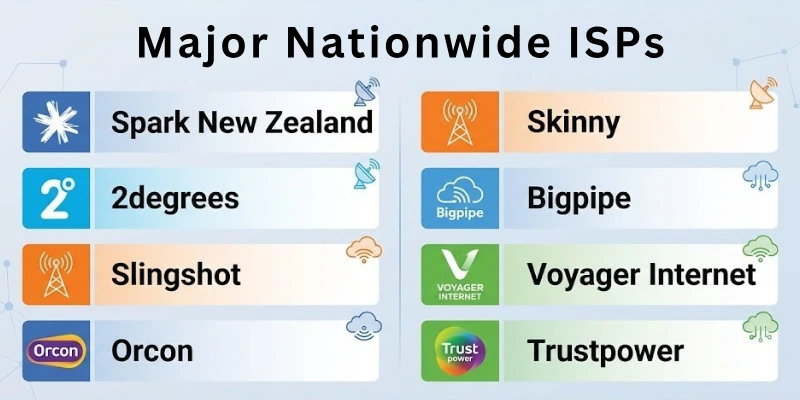
- Spark New Zealand
- One New Zealand (formerly Vodafone NZ)
- 2degrees
- Slingshot
- Orcon
- Skinny
- Bigpipe
- Voyager Internet
- Trustpower
2. Independent & Regional ISPs
- Compass Communications
- WorldxChange (WxC)
- Kiwilink
- Lightwire
- Inspire Net
- Solarix Networks
- Devoli
3. Wireless Internet Service Providers (WISPs)
- Wireless Nation
- Primo Wireless
- Wiz Wireless
- WheroNet
- Gravity Internet
- Accelerate Wireless
- Wireless Dynamics
- Kiwiwifi
4. Regional & Community ISPs
- Netspeed Data
- Orbit Broadband
- VelocityNet
- Vetta Online
- Vital NZ
- Countrynet NZ
- Morepork Online
- martinborough.net.nz
- RexNetworks
- WombatNET
- Xtreme Networks
- 360Net
- GlobiCom
- CloudLink Communications
- Prodigi Technology Services
- UFONE
- Engage Technology
Note: New Zealand has a diverse ISP market, including national carriers, regional fibre providers, and rural wireless operators. This list includes major, regional, and widely recognized internet service providers in New Zealand.
Let’s go deeper and learn more about these internet services in New Zealand.
Major Nationwide ISPs
New Zealand has a few large internet providers that cover most cities and towns. These companies run strong networks and serve a wide range of home and business users. They offer broad coverage and stable connections. Below are the major broadband providers in New Zealand:
1. Spark New Zealand
Spark New Zealand is one of the largest internet providers in the country. It connects homes and businesses across New Zealand through a wide network.
- Offers fibre, wireless, and mobile internet
- Provides bundled services like TV and mobile plans
- Gives modem and router options
- Has online account control tools
- Serves both home and business customers
Coverage Area
Spark covers most cities, towns, and many rural areas in New Zealand. It has one of the widest network reaches in the country.
Pricing and Packages
- Fibre Starter plan: around NZD 75 to 85 per month
- Fibre Max plan: around NZD 95 to 110 per month
- Wireless broadband: around NZD 60 to 75 per month
- Mobile + broadband bundles with discounted rates
Pros of Spark New Zealand
- Wide coverage across the country
- Stable and reliable connection
- Many plan options available
Cons of Spark New Zealand
- Prices are higher than those of some competitors
- Contract terms may apply to some plans
2. One New Zealand (formerly Vodafone NZ)
One New Zealand is a major telecom provider that offers internet and mobile services across the country. It operates under a well-known brand that many users in New Zealand already recognize.
- Provides fibre, broadband, and mobile internet
- Offers 4G and 5G mobile services
- Gives bundle deals with mobile plans
- Includes roaming services
- Has app-based account access
Coverage Area
One New Zealand covers major cities, regional towns, and many rural areas. It has strong mobile network coverage.
Pricing and Packages
- Fibre basic plan: around NZD 70 to 85 per month
- Fibre high-speed plan: around NZD 90 to 105 per month
- Unlimited broadband plans available
- Bundle deals with mobile services
Pros of One New Zealand
- Strong mobile and broadband network
- Wide coverage across the country
- Good bundle options
Cons of One New Zealand
- Customer service reviews are mixed
- Some plans include long-term contracts
3. 2degrees
2degrees is a growing provider in New Zealand that offers internet and mobile services with simple plans. It entered the market later than other major providers and continues to expand its presence.
- Offers fibre and mobile internet
- Provides unlimited data plans
- Gives flexible plan options
- Offers a modem for home setup
- Expands network coverage regularly
Coverage Area
2degrees covers most cities and continues to expand in regional areas. Its fibre service is available in urban locations.
Pricing and Packages
- Fibre plan: around NZD 65 to 80 per month
- Unlimited fibre plans available
- Mobile and broadband bundle offers
- Discounted rates for existing mobile users
Pros of 2degrees
- Competitive pricing
- Simple and easy plans
- Good bundle deals
Cons of 2degrees
- Coverage is still expanding in some areas
- Fewer premium features compared to larger providers
4. Slingshot
Slingshot is a home internet provider that offers broadband and fibre plans across New Zealand. It is known for focusing on the everyday internet needs of households.
- Provides fibre and broadband internet
- Offers unlimited data plans
- Includes streaming add-ons
- Uses a simple home setup
- Focuses on residential users
Coverage Area
Slingshot operates in cities and towns where fibre and broadband networks are available.
Pricing and Packages
- Fibre starter plan: around NZD 65 to 75 per month
- Fibre unlimited plan: around NZD 80 to 95 per month
- Add-ons available for entertainment services
Pros of Slingshot
- Affordable pricing
- Simple plan structure
- Easy setup for home users
Cons of Slingshot
- Limited features compared to other providers
- Depends on other network infrastructure
5. Orcon
Orcon is a long-running internet provider in New Zealand that started many years ago. It focuses mainly on broadband services and has built a strong presence over time in the market.
- Provides fibre and broadband internet plans
- Offers unlimited data options
- Gives gigabit speed plans in selected areas
- Includes modem with broadband setup
- Provides internet and power bundle options
Coverage Area
Orcon operates in many cities and towns where fibre networks are available. Its service depends on fibre infrastructure, so availability may vary by location.
Pricing and Packages
- Fibre basic plan: around NZD 70 to 85 per month
- Fibre high-speed plan: around NZD 90 to 105 per month
- Gigabit plans available in some regions
- Bundle plans with power services
Pros of Orcon
- Strong fibre internet performance
- Unlimited data in most plans
- Good value bundle options
Cons of Orcon
- Limited availability in rural areas
- Performance depends on fibre coverage
- Prices may increase over time
6. Skinny
Skinny is a budget-focused internet provider in New Zealand. It runs under the same network as Spark and offers simple plans for everyday users.
- Uses Spark’s network for internet services
- Offers broadband and mobile internet
- Provides prepaid-style mobile plans
- Includes wireless broadband options
- Gives simple online account management
Coverage Area
Skinny covers most areas where the Spark network is available. It reaches many cities, towns, and some rural locations through wireless services.
Pricing and Packages
- Wireless broadband: around NZD 60 to 70 per month
- Fibre plans: around NZD 65 to 85 per month
- Mobile plans with data bundles
- Combo deals for mobile and internet
Pros of Skinny
- Affordable pricing compared to many providers
- Wide coverage through the Spark network
- Simple plans with no complex setup
Cons of Skinny
- Fewer premium service options
- Limited advanced features
- Customer service is basic
7. Bigpipe
Bigpipe is an internet provider in New Zealand that focuses on simple broadband services. It operates as a digital-first brand with no physical stores.
- Provides fibre broadband plans
- Offers unlimited data usage
- No traditional call centre service
- Online-based customer communication
- Uses Spark network infrastructure
Coverage Area
BigPipe works in areas where fibre broadband is available. It mainly serves urban and suburban locations.
Pricing and Packages
- Fibre plans: around NZD 70 to 90 per month
- Unlimited data included in all plans
- No bundle services
- Straightforward single-plan options
Pros of Bigpipe
- Simple and easy plan structure
- Unlimited data on all plans
- Fully online service model
Cons of Bigpipe
- Limited plan variety
- No phone-based customer service
- Not suitable for users who prefer in-person help
8. Voyager Internet
Voyager Internet is a New Zealand-owned provider that offers broadband and communication services. It focuses on simple internet plans for users who prefer fewer options.
- Provides fibre and DSL broadband connections
- Offers unlimited data on all plans
- Includes both home and business services
- Gives hosting and domain services
- Allows users to bring their own modem
Coverage Area
Voyager operates across many parts of New Zealand where fibre or DSL networks are available. Coverage depends on your address and local infrastructure.
Pricing and Packages
- Fibre Starter plan: around NZD 65 per month
- Fibre unlimited plan: around NZD 99 to 115 per month
- Hyperfibre plan: around NZD 149 to 154 per month
- ADSL/VDSL plan: around NZD 105 to 110 per month
Pros of Voyager Internet
- Simple plan structure with clear options
- No contract plans available
- Unlimited data in all packages
- Good choice for both home and business
Cons of Voyager Internet
- Very few plan options
- Not available in all locations
- Modem not included in most plans
9. Trustpower
Trustpower is a New Zealand utility company that provides internet, along with power and other services. It mainly focuses on bundle plans that combine different household services in one package.
- Offers fibre, ADSL, and VDSL internet
- Provides bundle deals with power and gas
- Includes landline options
- Offers unlimited broadband plans
- Gives reward-based sign-up deals
Coverage Area
Trustpower provides internet services in many parts of New Zealand, including cities and regional areas. It uses different connection types to reach both urban and remote locations.
Pricing and Packages
- Broadband plans start from around NZD 84 per month
- Fibre plans with higher speed options available
- Bundle plans with power and internet
- Unlimited data plans included
Pros of Trustpower
- Bundle deals with multiple services
- Available in many regions
- Different plan types to choose from
- Includes extra sign-up rewards
Cons of Trustpower
- Bundle plans can feel confusing
- Prices depend on the combined services
- Not ideal for internet-only users
- Switching can be difficult due to contracts
Independent & Regional ISPs
Independent and regional ISPs in New Zealand serve specific areas instead of covering the whole country. These providers focus on cities, towns, or selected regions where they build strong local networks. In this section, you will see internet providers that work outside the large national companies.
1. Compass Communications
Compass Communications is a New Zealand-based internet provider that offers broadband and telecom services. It started in 1995 and serves both home and business users nationwide.
- Provides fibre and wireless broadband
- Offers phone and internet together
- Includes mobile services with broadband
- Gives business communication solutions
- Uses its own switching centres in major cities
Coverage Area
Compass works across New Zealand, mainly in cities and key regions where its network points are available.
Pricing and Packages
- Broadband plans start from around NZD 40 per month
- Older entry plans reported around NZD 50 to 60 per month
- Fibre and wireless pricing depend on speed and usage
- Custom plans available for business users
Advantages of Compass Communications
- Long presence in the New Zealand market
- Offers both home and business services
- Provides bundled telecom services
Disadvantages of Compass Communications
- Plan details are not clearly listed
- The focus is not strong on residential users
- Availability varies by region
2. WorldxChange (WxC)
WorldxChange is a New Zealand internet provider that focuses on broadband and communication services. It connects users with both local and international networks.
- Provides broadband and VoIP services
- Offers cloud-based communication systems
- Includes international calling options
- Gives business phone solutions
- Provides data connectivity services
Coverage Area
WorldxChange operates in urban areas and business locations where telecom infrastructure is available.
Pricing and Packages
- Pricing depends on service type
- Broadband plans vary by connection
- VoIP services are billed separately from internet plans
- Custom quotes provided for businesses
Advantages of WorldxChange
- Strong focus on communication services
- Suitable for office setups
- Offers global connectivity options
Disadvantages of WorldxChange
- Not focused on home users
- Pricing is not publicly fixed
- Requires custom setup for many services
3. Kiwilink
Kiwilink is a regional internet provider that delivers broadband services in selected parts of New Zealand. It focuses on local areas where fewer providers operate.
- Provides wireless and fibre broadband
- Offers internet plans for homes
- Includes installation in covered areas
- Gives local connectivity solutions
- Focuses on community-based service
Coverage Area
Kiwilink serves specific regions and small towns, with service limited to areas where its network is present.
Pricing and Packages
- Pricing varies by location
- Wireless plans based on speed levels
- Fibre plans available in limited zones
- Plans shared after availability check
Advantages of Kiwlink
- Serves areas with fewer options
- Local provider with regional focus
- Offers installation in remote areas
Disadvantages of Kiwlink
- Limited national coverage
- Fewer plan choices
- Speeds depend on the local network
4. Lightwire
Lightwire is an internet provider that focuses on rural and remote connectivity in New Zealand. It connects homes and businesses where traditional providers often do not reach.
- Provides wireless broadband services
- Offers fibre in selected areas
- Focuses on rural internet access
- Serves homes and business users
- Delivers voice and data services
Coverage Area
Lightwire mainly serves rural and remote areas, along with some urban locations where its network is available.
Pricing and Packages
- 90GB plan: around NZD 79 per month
- 300GB plan: around NZD 95 per month
- Unlimited plans: around NZD 139 to 155 per month
- Extra data charged per GB
Advantages of Lightwire
- Strong focus on rural connectivity
- Works in areas with limited options
- Offers multiple data plans
Disadvantages of Lightwire
- Prices are higher than urban fibre plans
- Speed depends on the wireless signal
- Availability is location-based
5. Inspire Net
Inspire Net is a New Zealand internet provider that focuses strongly on local and regional connectivity. It serves homes, farms, and small communities, especially in the lower North Island.
- Provides fibre, wireless, and DSL internet
- Offers rural internet solutions in remote areas
- Includes prepaid and monthly plan options
- Gives free router rental on many plans
- Operates its own local support team
Coverage Area
Inspire Net operates mainly in the Manawatu and nearby regions, with expanding wireless coverage in rural locations. It does not operate nationwide but focuses on selected service areas.
Pricing and Packages
- DSL plans start around NZD 65 per month
- Fibre plans start around NZD 75 per month
- Wireless broadband starts around NZD 70 to 75 per month
- Prepaid plans available from about NZD 27.50 per month
Advantages of Inspire Net
- Strong local customer support
- Good coverage in rural regions
- Multiple plan types available
Disadvantages of Inspire Net
- Limited national coverage
- Speed depends on the area type
- Not available in all cities
6. Solarix Networks
Solarix Networks is a New Zealand provider that focuses on business internet and communication services. It mainly supports companies that need managed connectivity and technical solutions.
- Provides business broadband services
- Offers network management solutions
- Includes VoIP and cloud services
- Supports customised internet setups
- Works with enterprise clients
Coverage Area
Solarix Networks operates mainly in business centers and selected regions across New Zealand. Its services depend on business network availability rather than full residential coverage.
Pricing and Packages
- Business broadband plans start around NZD 80 to 120 per month
- Custom pricing for enterprise networks
- VoIP and cloud services are priced separately
- Large business solutions require quotations
Advantages of Solarix Networks
- Strong focus on business needs
- Flexible network solutions
- Custom service options
Disadvantages of Solarix Networks
- Not designed for home users
- Pricing is not publicly fixed
- Limited consumer availability
7. Devoli
Devoli is a New Zealand-based wholesale internet provider that supports many retail ISPs. It builds infrastructure and systems that other internet companies use to deliver services.
- Provides wholesale broadband services
- Supports ISP network systems
- Offers cloud and connectivity tools
- Manages internet infrastructure for partners
- Focuses on telecom backend services
Coverage Area
Devoli operates across New Zealand through partner ISPs rather than directly providing consumer services. Its network supports many providers in both urban and regional areas.
Pricing and Packages
- No direct public home plans
- Wholesale pricing based on ISP agreements
- Enterprise-level network pricing only
- Costs depend on partner contracts
Advantages of Devoli
- Powers many ISP networks in NZ
- Strong backend infrastructure
- Supports scalable internet services
Disadvantages of Devoli
- Not available directly for home users
- No public pricing plans
- Indirect service model
Wireless Internet Service Providers (WISPs)
Wireless internet providers in New Zealand deliver connections without relying only on fixed fibre lines. They serve areas where wired networks are limited or not available. Many of these companies focus on rural and remote homes. Here, you will see providers that use wireless technology to connect users across different regions.
1. Wireless Nation
Wireless Nation is a New Zealand internet provider that focuses on wireless broadband services. It serves homes and businesses, especially in areas where fibre connections are not available.
- Provides fixed wireless broadband services
- Offers mobile broadband options
- Includes rural connectivity solutions
- Gives data plans with different usage levels
- Supports home and business setups
Coverage Area
Wireless Nation operates across many rural and regional parts of New Zealand, along with selected urban areas where wireless coverage is available.
Pricing and Packages
- Wireless broadband plans start around NZD 70 to 85 per month
- Higher data plans cost around NZD 90 to 110 per month
- Rural plans vary based on location and signal type
- Business plans are priced separately
Benefits of Wireless Nation
- Works well in rural locations
- Offers flexible wireless options
- Covers areas without fibre access
Limitations of Wireless Nation
- Speed depends on signal strength
- Performance changes by location
- Not as stable as fibre connections
2. Primo Wireless
Primo Wireless is a regional internet provider that focuses on wireless broadband in selected areas of New Zealand. It aims to connect users in places where wired internet is limited.
- Provides fixed wireless internet
- Offers home broadband plans
- Includes installation services in covered areas
- Gives local network support
- Focuses on rural connectivity
Coverage Area
Primo Wireless operates in specific regional locations and rural communities where its wireless towers are available.
Pricing and Packages
- Basic wireless plans start around NZD 60 to 75 per month
- Mid-range plans cost around NZD 80 to 95 per month
- Unlimited data plans available in selected areas
- Pricing depends on location and signal type
Benefits of Primo Wireless
- Good option for rural users
- Simple installation process
- Strong local customer support
Limitations of Primo Wireless
- Limited coverage areas
- Speed varies by location
- Limited number of broadband plan options
3. Wiz Wireless
Wiz Wireless is a New Zealand-based wireless internet provider that serves both rural and semi-urban areas. It uses wireless technology to deliver internet where fibre is not available.
- Provides fixed wireless broadband
- Offers home internet plans
- Includes rural connectivity services
- Gives data-based packages
- Supports local installations
Coverage Area
Wiz Wireless operates in selected parts of New Zealand, mainly in rural regions and smaller communities with wireless infrastructure.
Pricing and Packages
- Entry wireless plans start around NZD 65 per month
- Standard plans range from NZD 75 to 90 per month
- Unlimited plans available in some areas
- Pricing changes based on coverage zone
Benefits of Whiz Wireless
- Works in remote areas
- Simple setup process
- Useful where fibre is not available
Limitations of Whiz Wireless
- Coverage is limited
- Speed depends on signal quality
- Not suitable for all locations
4. WheroNet
WheroNet is a regional wireless internet provider in New Zealand that focuses on delivering broadband to rural communities. It helps connect areas with limited internet infrastructure.
- Provides fixed wireless broadband
- Offers rural internet solutions
- Includes home connectivity plans
- Gives local technical support
- Focuses on community coverage
Coverage Area
WheroNet serves specific rural and regional parts of New Zealand where wireless towers and network coverage are available.
Pricing and Packages
- Basic plans start around NZD 60 to 75 per month
- Standard plans range from NZD 80 to 95 per month
- Unlimited options available in selected areas
- Pricing depends on location and service type
Benefits of WheroNet
- Good coverage in rural zones
- Provides internet in low-connectivity areas
- Focuses on specific local areas instead of nationwide service
Limitations of WheroNet
- Covers only certain regions instead of full coverage
- Speed varies by area
- Not available everywhere
5. Gravity Internet
Gravity Internet is a wireless provider that delivers internet to homes in areas where fibre is not available. It mainly focuses on connecting users in rural locations.
- Provides fixed wireless broadband connections
- Offers home internet plans with data limits
- Uses local towers for signal delivery
- Supports installation at residential properties
- Gives basic router setup for customers
Coverage Area
It works in selected rural and semi-rural areas. It does not operate in most major cities.
Pricing and Packages
- Basic plans start around NZD 65 per month
- Standard plans range from NZD 75 to 90 per month
- Unlimited options available in some areas
- Pricing changes based on coverage location
Benefits of Gravity Internet
- Brings internet to areas without fibre access
- Simple setup process at home
- Local installation support available
Limitations of Gravity Internet
- Coverage is limited to certain areas
- Internet speed depends on signal strength
- Few plan options available
6. Accelerate Wireless
Accelerate Wireless provides internet using wireless networks for homes in areas without fibre connections. It focuses on small towns and outer regions.
- Provides fixed wireless broadband service
- Offers residential internet plans
- Uses regional wireless towers
- Includes installation for covered homes
- Supports basic modem setup
Coverage Area
It operates in selected regional and rural areas. It is not widely available in major cities.
Pricing and Packages
- Entry plans start around NZD 60 to 70 per month
- Standard plans range from NZD 75 to 95 per month
- Unlimited data available in selected areas
- Pricing depends on location
Benefits of Accelerate Wireless
- Works well in areas without fibre
- Quick installation process
- Simple internet plans
Limitations of Accelerate Wireless
- Limited network coverage
- Speed changes with location and signal strength
- Fewer advanced plan options
7. Wireless Dynamics
Wireless Dynamics delivers internet through wireless technology to reach homes in non-fibre areas. It focuses on connecting users in rural and remote zones.
- Offers fixed wireless internet connections
- Provides home broadband plans
- Uses local network towers
- Supports rural installations
- Gives basic internet setup assistance
Coverage Area
It serves rural and outer regional areas. Its service is available only in selected locations.
Pricing and Packages
- Basic plans start around NZD 65 per month
- Mid-range plans around NZD 80 to 95 per month
- Unlimited plans in selected regions
- Pricing depends on location
Benefits of Wireless Dynamics
- Connects homes in remote areas
- Simple installation process
- Local service availability
Limitations of Wireless Dynamics
- Limited coverage across regions
- Speed depends on signal quality
- Not suitable for all locations
8. Kiwiwifi
Kiwiwifi is a local wireless internet provider that serves small towns and rural communities. It focuses on giving internet access in areas where fibre is not widely available.
- Provides fixed wireless broadband
- Offers residential internet services
- Uses local signal towers
- Includes home installation support
- Focuses on community-based access
Coverage Area
It works in selected rural and small-town areas.
Pricing and Packages
- Plans start around NZD 60 to 75 per month
- Standard plans range from NZD 75 to 90 per month
- Unlimited options available in some areas
- Pricing varies by location
Benefits of Kiwiwifi
- Easy setup process
- Provides internet in rural communities
- Local service focus with direct support
Limitations of Kiwiwifi
- Limited availability
- Speed depends on signal strength
- Fewer plan options
Regional and Community ISPs
Regional and community ISPs play an important role in connecting people outside major city networks. They target specific locations rather than the entire country. These internet companies work closely with communities in different areas.
- Netspeed Data: Serves households in smaller towns and rural areas with home internet connections.
- Orbit Broadband: Runs fibre and wireless internet services across selected regional communities.
- VelocityNet: Connects residential users with broadband plans built for local areas.
- Vetta Online: Supplies internet plans for homes and small businesses in regional locations.
- Vital NZ: Focuses on broadband and communication services for business and community users.
- Countrynet NZ: Connects rural homes and farms where fibre networks are limited.
- Morepork Online: Extends wireless internet service to rural and faraway areas.
- martinborough.net.nz: Runs local internet services for the Martinborough community.
- RexNetworks: Links regional households with broadband services in selected areas.
- WombatNET: Focuses on small towns where internet options are fewer.
- Xtreme Networks: Works in selected zones with fibre and wireless internet.
- 360Net: Focuses on broadband services for regional households.
- GlobiCom: Supports homes and small businesses with internet services in local areas.
- CloudLink Communications: Works in regional zones with connectivity solutions.
- Prodigi Technology Services: Handles internet and IT-based connectivity for selected clients.
- UFONE: Provides wireless internet access for rural homes.
- Engage Technology: Offers communication services to business and community users.
Comparison of Internet Providers in New Zealand
ISP companies in New Zealand operate in different ways. Some focus on low-cost plans, while others focus on speed, coverage, or extra features. Each provider also uses different network systems and plan structures. The table below shows the main differences.
| ISP | Connection Type | Network Ownership | Extra Services | Monthly Price Range (NZD) |
| Spark New Zealand | Fibre, VDSL, Wireless | Own + wholesale mix | Mobile + entertainment bundles | ~$75 – $110 |
| One New Zealand | Fibre, Wireless Broadband | Strong network control | Mobile integration | ~$75 – $115 |
| 2degrees | Fibre, VDSL | Partially owned and leased | Mobile bundles | ~$70 – $100 |
| Slingshot | Fibre, VDSL, Wireless | Wholesale network use | Power bundle options | ~$65 – $95 |
| Orcon | Fibre, DSL | Wholesale network use | Internet + power bundles | ~$70 – $105 |
| Skinny | Wireless, Fibre | Spark network | Mobile + broadband combo | ~$65 – $85 |
| Bigpipe | Fibre broadband | Spark network | No extra services | ~$70 – $90 |
| Voyager Internet | Fibre, DSL | Wholesale + own systems | Hosting + domain services | ~$65 – $115 |
| Trustpower | Fibre, VDSL, ADSL | Wholesale network use | Power + gas bundles | ~$84 – $110+ |
Key Differences of Top ISPs in New Zealand
Internet service providers in New Zealand work in different ways and do not follow one fixed system. Each company targets different areas and user needs, from nationwide coverage to small local regions. They differ in the following way:
- Spark New Zealand offers nationwide broadband and bundles
- One New Zealand focuses on the internet and mobile services together
- 2degrees provides affordable home broadband plans
- Slingshot targets budget-friendly internet users
- Orcon specializes in home broadband services
- Skinny uses Spark’s network to offer low-cost internet plans
- Bigpipe provides unlimited fibre internet
- Voyager Internet serves both home and business users
- Trustpower combines the internet with power and utility services
Best Choice of New Zealand ISPs by Use
Some people need stable fibre for long-term home use, while others look for low-cost or mobile-friendly options. Each ISP serves a different purpose. This part guides you to match the right provider with your specific need:
- For nationwide fibre internet and long-term stability – Spark New Zealand
- For mobile-focused internet and bundled services – One New Zealand
- For affordable home broadband plans – 2degrees
- For budget-friendly internet users – Slingshot
- For home internet without extra features – Bigpipe
- For combined internet and utility services – Trustpower
- For home and business internet solutions – Voyager Internet
- For low-cost basic broadband access – Skinny
- For simple broadband in selected regions – Orcon
Factors to Consider When Choosing an ISP in New Zealand
Each internet provider in NZ works with different networks, pricing, and service areas. The right choice depends on where you live and how you use the internet. You should compare some important factors before selecting a plan.
- Coverage Area: Check if the provider works in your location. Some ISPs cover most cities, while others only serve selected regions or rural zones.
- Internet Speed: Look at the speed offered in the plan. Faster speeds help with smooth browsing, streaming, and online work.
- Data Plans: See if the provider gives unlimited data or has monthly limits. Unlimited plans remove usage worries.
- Monthly Cost: Compare the monthly price of different ISPs. Some keep prices low, while others charge more for extra features.
- Installation Process: Check how quickly the internet gets installed. Some providers activate services faster than others, depending on the area.
- Contract Rules: Look at contract length and conditions. Some ISPs lock you into long plans, while others allow more flexibility.
- Customer Contact Options: Check how you can reach support. Some companies use phones and stores, while others rely on online chat or apps.
- Extra Services: See if the ISP includes add-ons like mobile plans, TV services, or power bundles. These can add extra value depending on your needs.
Types of Internet Connections in New Zealand
New Zealand uses different types of internet connections. Each connection type comes with its own performance level and availability. Here are the main types of internet connections used in the country.
- Fibre Internet: It provides high-speed internet through underground fibre connections.
- VDSL (Copper-Based Internet): VDSL uses telephone lines and gives moderate speeds that depend on distance from the exchange.
- Wireless Broadband: It connects through mobile towers and works well where cables are not available.
- Mobile Broadband: It uses 4G or 5G networks and offers flexible internet access on the go.
- Satellite Internet: It works in remote areas and provides coverage where other connections are not available, but speeds can vary.
Internet Speed in New Zealand
It depends on the type of connection and location. Fibre delivers the fastest and most stable performance, while wireless and rural connections vary more based on coverage and signal strength. Let’s compare the internet speeds in New Zealand.
- Fibre Internet Speed: Most standard fibre plans in New Zealand offer around 300 Mbps download and 100 Mbps upload. Some advanced fibre or hyperfibre plans can reach up to 8000 Mbps in selected areas.
- Average Real-World Speed: The median fixed internet speed in New Zealand is around 214 Mbps download for typical users.
- Wireless Broadband Speed: Wireless connections usually average around 30 to 80 Mbps download, depending on tower distance and network load.
- VDSL / Copper Speed: Older VDSL connections usually reach about 30 to 40 Mbps download, which is slower than fibre.
- Peak Fibre Performance: High-end fibre connections in real conditions can reach 800+ Mbps average download speeds in strong network areas.
Challenges of the Internet in New Zealand
Internet quality in New Zealand is strong in many urban areas, but it remains challenging in a few areas. These issues depend on location, network type, and provider. Here are the main challenges people experience.
- Limited Rural Coverage: Some rural and remote areas still have limited fibre access, so users depend on wireless or satellite connections.
- Speed Variation: Internet speed can vary a lot between cities and rural regions, even on similar plans.
- Higher Costs: Prices can be higher in locations where infrastructure is harder to build or maintain.
- Peak Time Slowdowns: Speeds may slow down during peak hours when many users are online at the same time.
- Slow Installation: Fibre installation can take time in new housing areas or locations without existing infrastructure.
- Restricted Packages: Some rural-focused plans offer fewer options compared to urban broadband packages.
Conclusion
We looked at ISPs in New Zealand and how they differ in coverage, speed, pricing, and service type, from nationwide companies to regional and wireless providers. After that, we compared their key features and saw how each one fits different user needs, along with internet speeds, connection types, and the challenges users face across different areas.
Overall, New Zealand has a wide range of internet providers, and no single option works for everyone. Some ISPs focus on speed and nationwide coverage, while others focus on rural access or lower-cost plans. Your choice depends on your location and personal needs.
Also, take a moment to read the FAQs below for helpful answers.
FAQs
I have explained a few common questions about ISPs in New Zealand.
The best internet provider depends on your location and needs. Some companies perform better in cities, while others work well in rural areas. You should check speed, price, coverage, service type, and plan details before choosing.
Fibre internet is widely available in cities and towns. However, some rural areas still do not have full fibre access. In those places, people use wireless or satellite connections. Availability depends on local infrastructure.
The average internet speed in New Zealand is over 200 Mbps for fixed broadband. Fibre connections usually offer higher speeds than other types. Actual speed depends on your plan and provider. Your location also affects performance.
Fibre internet is the most reliable connection type in New Zealand. It provides stable speed and low interruptions. Other options, like wireless, can vary based on signal strength. Reliability also depends on network conditions.
Internet plans in New Zealand come in different price ranges. Some providers offer low-cost plans with basic features. Others charge more for higher speeds or extra services. Prices depend on the plan type and provider.
Yes, many rural areas in New Zealand have internet access through wireless and satellite services. Some providers also offer fixed wireless broadband in smaller towns and remote regions.
Several factors affect internet speed in New Zealand. These include connection type, network traffic, and location. Weather and signal strength can also impact wireless connections. Your chosen plan also plays a role.
Most major ISPs in New Zealand offer unlimited data plans. However, some smaller or rural providers may have limits. It is important to check the plan details before choosing. Unlimited plans are common in fibre connections. Some plans may not give full speed at all times.
Mobile broadband works well for users who need internet on the go. It is easy to set up and does not require cables. Speeds depend on network coverage and signal strength. It is useful in areas without fixed connections.
Internet use in New Zealand is high, especially with fibre expansion. Many households rely on fast broadband for daily activities. The country has improved its digital infrastructure over time. Internet connectivity now reaches more areas than before.






- Be Respectful
- Stay Relevant
- Stay Positive
- True Feedback
- Encourage Discussion
- Avoid Spamming
- No Fake News
- Don't Copy-Paste
- No Personal Attacks
- Be Respectful
- Stay Relevant
- Stay Positive
- True Feedback
- Encourage Discussion
- Avoid Spamming
- No Fake News
- Don't Copy-Paste
- No Personal Attacks
