Internet Frequency Band/Spectrum: Types, Uses, Benefits & Limits
Published: 18 May 2026
Every time a page loads or a video plays, a system called the spectrum handles the work. It splits wireless signals into different ranges so devices can send and receive data without interference. I have tested many connections over the years, and one thing always stands out. The wrong band can slow everything down, even with a strong internet package.
Now we will explain the internet frequency band/spectrum step by step, explore different bands, and show how each one works. This will help improve speed, fix common issues, and make better use of the internet.
Let’s first understand the basics before moving ahead.
What Is Frequency in Networking?
Frequency in networking refers to how many times a signal moves back and forth per second. It shows how many waves carry data within a given time. Frequency is measured in Hertz (Hz), and higher values, such as MHz and GHz, mean faster signal cycles.
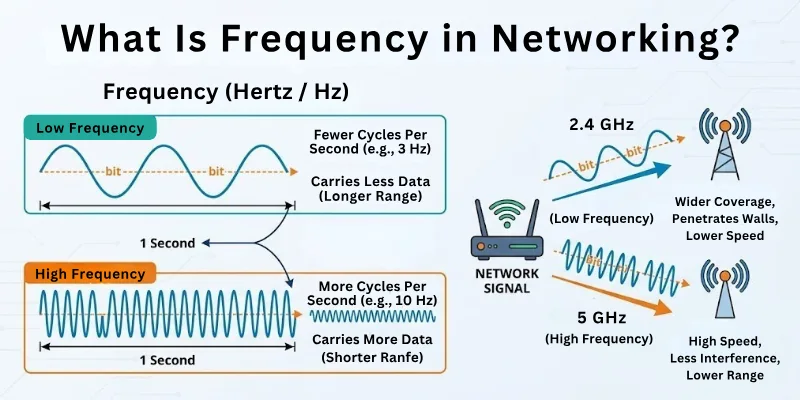
In simple terms, frequency controls how internet signals travel through the air or cables. Low frequencies send data over longer distances but at slower speeds, while high frequencies send data much faster but cover shorter distances.
What Is an Internet Frequency Band?
An internet frequency band, also called a spectrum, is a specific range of wireless signals used for internet communication in systems such as WiFi and mobile networks. Devices do not use a single signal. They switch between different bands based on speed and distance requirements.
In basic terms, it decides how your internet behaves in real use. Low bands give wider coverage but slower speed. High bands give faster speed but shorter range.
Types of Internet Frequency Bands
They divide wireless signals into different ranges. Each range handles internet speed and coverage differently. Devices use these bands to connect to WiFi, mobile networks, and other wireless systems.
The main types are as follows:
- Low Frequency Band (< 1 GHz)
- Mid Frequency Band (1 GHz – 10 GHz)
- High Frequency Band (> 10 GHz / mmWave)
Let’s go through each type in full detail.
1. Low-Frequency Band
Definition:
The low-frequency band is a wireless signal that operates at lower speeds but travels longer distances. It includes frequencies below 1 GHz. It supports wide coverage and works better in areas where signals need to pass through walls, buildings, or open land.
Example:
When you travel outside a city, your phone still catches a signal because mobile networks often use low-frequency bands like 700 MHz to cover long distances.
Features of the low-frequency band:
- Covers long distances with a stable connection
- Passes through walls and obstacles more easily
- Gives lower internet speeds compared to higher bands
- Works well in rural and less crowded areas
- Supports strong signal coverage in large spaces
- Handles heavy traffic in a simple and steady way
2. Mid-Frequency Band
Definition:
The mid-frequency band is a network band that balances speed and coverage. It works between 1 GHz and 10 GHz. It delivers faster data than low-frequency bands but does not travel as far. It suits areas where both speed and a stable connection matter.
Example:
When you use 4G or 5G in a city, your phone often connects through mid-frequency bands. It gives smooth browsing, video streaming, and app use in daily life.
Characteristics of the mid-frequency band:
- Offers a balance between speed and coverage
- Gives faster internet than low-frequency bands
- Works well in urban and suburban areas
- Handles more users in busy networks
- Provides stable performance for daily internet use
- Struggles to cover very long distances without more towers
3. High-Frequency Band
Definition:
The high-frequency band is a frequency range that operates at very high speeds but covers short distances. It works above 10 GHz, including mmWave signals. It delivers fast data transfer but loses strength quickly as distance increases or obstacles appear.
Example:
In crowded city areas, some 5G networks use high-frequency bands to give very fast internet for short-range use, such as in stadiums, airports, and dense urban zones.
Aspects of the high-frequency band:
- Delivers very high internet speeds
- Works best over short distances
- Weakens quickly when obstacles come in the way
- Performs well in dense city environments
- Supports heavy data use in small areas
- Needs more towers for wide coverage
Common Internet Frequency Bands Explained
Internet connections use different frequency bands to send and receive data. Each band works at a different speed and range. Devices switch between these bands to give better performance in different places and conditions.
These are the most common frequency bands:
- 2.4 GHz Band
- 5 GHz Band
- 6 GHz Band (WiFi 6E and WiFi 7)
- Cellular Bands (4G and 5G Networks)
The explanation of each type is given below.
1. 2.4 GHz Band
Overview:
The 2.4 GHz band is a frequency band that many WiFi devices use to send and receive data. It focuses more on coverage than speed and works well in homes and public spaces.
Example:
When you use WiFi in another room and still stay connected, your device often uses the 2.4 GHz band to keep the signal strong.
Characteristics of the 2.4 GHz band:
- Covers a wide area in homes and buildings
- Passes through walls and objects more easily
- Gives a lower speed compared to higher bands
- Faces more interference from other devices like Bluetooth and microwaves
- Works well for basic internet use, like browsing and emails
- Connects more devices over longer distances in a stable way
2. 5 GHz Band
Overview:
The 5 GHz band is a network band that delivers higher internet speed over a shorter distance. It focuses more on performance than coverage and works best when the device stays close to the router.
Example:
When you stream videos or play online games near your WiFi router, your device often uses the 5 GHz band for faster and smoother performance.
Properties of the 5 GHz band:
- Gives faster internet speed than lower bands
- Works best at short- to medium-range
- Faces less interference from other devices
- Struggles to pass through thick walls and obstacles
- Supports smooth video streaming and gaming
- Performs better in less crowded areas of a home or office
3. 6 GHz Band
Overview:
The 6 GHz band is a newer wireless range that supports very high-speed internet with low delay. It works with modern WiFi standards like Wi-Fi 6E and Wi-Fi 7 to improve performance and reduce network congestion.
Example:
When you use the latest router with Wi-Fi 6E or Wi-Fi 7, your device can connect to the 6 GHz band for smoother streaming and faster downloads.
Key Points of the 6 GHz band:
- Delivers very high internet speed
- Works with Wi-Fi 6E and Wi-Fi 7 devices
- Offers less network congestion compared to older bands
- Provides low delay for gaming and video calls
- Works best at a short distance from the router
- Needs modern devices to access this band
4. Cellular Bands (4G and 5G Networks)
Overview:
Cellular bands are wireless frequency ranges used by mobile networks to provide internet and calls. These bands help mobile towers send data to your phone without wires. Modern networks like 4G and 5G use different bands to balance speed, coverage, and performance.
Example:
When you use mobile data on your phone while traveling or outside your home WiFi, your connection runs on cellular bands used by 4G or 5G networks.
Features of cellular band:
- Provides internet through mobile networks instead of WiFi
- Works across cities, highways, and rural areas
- 4G bands focus on stable coverage and decent speed
- 5G bands deliver very high speed with low delay
- Signal strength changes based on distance from towers
- Supports voice calls, messages, and the internet at the same time
Advantages of Different Frequency Bands
Different frequency bands play an important role in how your internet works every day. Each band gives its own benefits based on speed, range, and usage. Below are the benefits of each frequency band.
Low-Frequency Band
Low-frequency bands work best when signals need to travel far and stay stable in weak coverage areas. They provide basic communication even in low-signal areas.
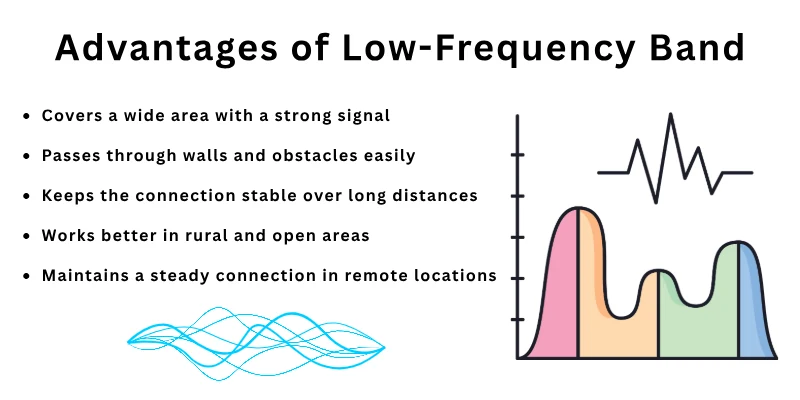
- Covers a wide area with a strong signal
- Passes through walls and obstacles easily
- Keeps the connection stable over long distances
- Works better in rural and open areas
- Maintains a steady connection in remote locations
Mid-Frequency Band
Mid-frequency bands balance speed and coverage, making them useful for most everyday internet use. They support both performance and reach in crowded places.
- Gives a good balance between speed and coverage
- Works well in cities with many users
- Handles multiple devices without slowing down
- Supports smooth video streaming and daily use
- Keeps the connection stable in suburban areas
High-Frequency Band
High-frequency bands focus on delivering very fast internet for heavy online tasks. They work best in short-range setups where speed matters more than distance.
- Provides a very high internet speed
- Reduces delay during online activities
- Handles heavy data use without slowing down
- Allows uninterrupted gaming and HD video streaming
- Works well in crowded areas like stadiums and malls
Cellular Band
Cellular bands keep you connected through mobile networks without relying on WiFi. They make internet access possible in almost all outdoor areas and while traveling.
- Gives internet access in many places
- Works while you are moving
- Keeps a stable connection outdoors
- Allows calls and messaging along with the internet
- Helps when WiFi is not available
Limitations of Different Frequency Bands
Different frequency bands also come with some drawbacks. Each band has its own limits in speed, range, and performance. Below are the disadvantages of frequency bands.
Low-Frequency Band
Low-frequency bands focus more on coverage, so they lose speed and struggle in high-demand situations.
- Gives a lower internet speed
- Struggles with heavy tasks
- Faces more network congestion in busy areas
- Not suitable for high-speed gaming or streaming
- Handles less data compared to other bands
Mid-Frequency Band
Mid-frequency bands balance speed and range, but they still face some limits in extreme conditions.
- Covers a shorter distance compared to low-frequency bands
- Slows down in very crowded areas
- Needs more towers to keep a strong connection
- Gives less speed than high-frequency bands
- The signal becomes weaker as the distance increases
High-Frequency Band
High-frequency bands deliver very high speed, but they work only in a short range and lose strength quickly.
- Covers a very small area
- Weakens when passing through walls and obstacles
- Requires many small towers for coverage
- Does not stay stable over long distances
- Works only in limited outdoor areas
Cellular Band
Cellular bands depend on network towers, so their performance changes based on location and signal strength.
- The signal drops in remote areas
- Internet speed slows down during high traffic
- Performance depends on the distance from the towers
- Indoor signal may be unstable in some places
- Coverage changes from one location to another
Uses of Frequency Spectrum
The frequency spectrum has an important role in modern communication systems. Many services rely on it to work properly every day. Without it, most wireless systems would not function as they do today.
Here are some main uses of the frequency spectrum:
- Mobile network connection: Mobile networks work through wireless signals to connect calls and the internet on your phone in different locations.
- WiFi internet access: Wi-Fi uses wireless signals to provide wireless internet in homes, offices, and public places.
- Radio broadcasting: Radio stations use signal waves to deliver music, news, and programs.
- TV signal transmission: Television networks utilize wireless signals to send audio and video to TV screens.
- Satellite communication: Satellites send signals for navigation, weather updates, and global communication.
- GPS Navigation: GPS systems rely on signals to show location and guide directions on maps.
- Emergency Services: Police, fire services, and ambulances employ frequency bands to stay connected during emergencies.
- Air Traffic: Airplanes and control towers use frequency signals to manage flight routes and ensure safe travel.
Which Frequency Band Is Best for Your Needs?
Different frequency bands work better in different situations. The right choice depends on how you use the internet, where you are, and what kind of speed or coverage you need. Each band has its own strength, so no single option fits every use case.
Below is a simple guide to help you choose the right frequency band for your needs.
1. Low Frequency Band: Best for Wide Coverage
Low-frequency bands work well when you need a strong connection over long distances. They are useful in places where signals must travel far and pass through walls or open areas.
- Choose it for rural and remote areas
- Use it for basic internet tasks like browsing and email
- Works better when coverage matters more than speed
2. Mid-Frequency Band: Best for Everyday Use
Mid-frequency bands give a balance between speed and coverage. They work well in cities and areas with many users.
- Choose it for daily internet use
- Good for streaming, social media, and video calls
- Works well in urban and suburban areas
3. High-Frequency Band: Best for Fast Performance
High-frequency bands deliver very fast internet, but only over short distances. They work best when you stay close to the source.
- Choose it for gaming and HD streaming
- Best for crowded places like stadiums and malls
- Works well when speed matters more than distance
4. Cellular Band: Best for Mobile Use
Cellular bands keep you connected when you are outside WiFi range. They work through mobile networks and support internet access on the move.
- Choose it for travel and outdoor use
- Useful when WiFi is not available
- Works across different locations through mobile networks
How Frequency Spectrum Works
The frequency spectrum works by dividing a wide range of signals into smaller parts. Each part is used by different services, so they can send and receive data without mixing. It also helps many devices work at the same time without interruption.
The following are the main points of how the spectrum works:
- Signal Division: The spectrum splits signals into different frequency bands so each service gets its own space.
- Usage: Each band is given to a specific service like mobile networks, WiFi, or broadcasting.
- Data Transmission: Devices send data through their assigned frequency band to reach the correct receiver.
- Interference Control: Separate frequency ranges help reduce signal overlap between different services.
- Spectrum Management: Authorities manage and control frequency use to keep communication stable and organized.
Frequency Spectrum vs Bandwidth: Differences
The frequency spectrum and bandwidth are closely related, but they are not the same. The spectrum covers all available frequencies, while bandwidth is only a small part of it used for data transfer.
The table below shows the main differences:
| Feature | Frequency Spectrum | Bandwidth |
| Type | Full range of all wireless frequencies | A small part of the spectrum is used for data |
| Size | Very wide range | Narrow portion of the spectrum |
| Function | Carries all types of wireless communication | Controls data transfer speed and capacity |
| Purpose | Supports many communication services | Defines how much data can pass at one time |
| Use | Used by mobile, WiFi, radio, TV, and satellites | Used by individual connections and networks |
| Focus | Overall communication system | Data speed and performance |
Tools to Optimize Frequency Band Usage
Frequency bands need proper management to avoid interference and improve network performance. Different tools help control how signals are used and shared. These tools also help balance speed, coverage, and capacity in wireless systems.
You can see some common tools below:
- Spectrum analyzer: It checks how different frequency signals are being used. It helps detect interference and unused frequency space.
- Network management system: It monitors and controls network performance. It helps manage traffic and keeps connections stable.
- Frequency planning tools: These tools distribute specific frequency bands to different services. They reduce overlap and improve signal clarity.
- Load balancing tools: They divide network traffic across different frequencies. This prevents congestion and improves speed.
- Interference detection tools: These tools find unwanted signals that disturb communication. They help maintain strong and safe connections.
Conclusion
You now understand what internet frequency bands/spectrum are and how they work, along with the different types of frequency bands, their uses, advantages, and limitations. We also discussed how bandwidth differs from frequency and explored the tools used to manage frequency usage in networks.
Wireless communication depends on different frequency ranges to deliver internet, calls, and data. Each band has its own role, and no single band can handle every situation alone. That is why networks rely on multiple frequency bands.
Frequently asked questions are included below. Take a look.
FAQs
Below are some helpful answers to common questions on the internet frequency band or spectrum.
WiFi frequency bands decide how fast your internet runs and how far the signal reaches. The 2.4 GHz band covers a larger area but gives lower speed. The 5 GHz and 6 GHz bands give higher speeds but work only at short distances. This is why your speed changes when you move away from the router.
Mobile networks use different frequency ranges to balance speed and coverage. Low frequencies cover large areas and travel long distances. High frequencies give faster speed but work in smaller areas. This mix helps users get both coverage and performance in different places.
The best frequency band for fast home internet is usually 5 GHz or 6 GHz. These bands provide higher speeds and lower latency. They work best when you stay close to the router. The 2.4 GHz band performs better over longer distances inside the house.
The frequency spectrum gives space for all wireless signals to travel. It separates different services like mobile, WiFi, radio, and TV. This separation prevents signal mix-ups and keeps communication clear. Without it, devices would face constant interference.
The 5 GHz band carries more data at higher speeds. However, it loses strength faster when passing through walls or over long distances. The 2.4 GHz band travels farther but carries data at slower speeds. This difference occurs because each frequency behaves differently in space.
Network providers check location, user load, and required speed before choosing a band. They use low bands for wide coverage in rural areas. They use mid bands in cities for balance. They use high bands in crowded places for very fast internet in small areas.
Too many users on one band slow down the network. Data traffic increases and signals overlap. This causes delays, buffering, and weak connections. The network may also drop speed during peak hours.
The frequency spectrum is the full range of wireless signals. Bandwidth is the amount of data that moves through a connection at one time. Spectrum shows “space for signals,” while bandwidth shows “data flow speed.” Both work together in communication systems.
No single frequency band can handle all needs. Low bands give coverage but slow speeds. High bands give speed but short range. Networks use multiple bands together to balance performance.
Overloaded bands slow down the internet speed. Users face delays in loading pages and buffering in videos. Calls may drop or sound unclear. This usually happens in crowded areas during peak time.
You can check bandwidth using online speed test tools. These tools show download speed, upload speed, and latency. Many internet providers also give apps for checking usage. Higher numbers mean better data flow capacity.
In Pakistan, mobile and internet services use different frequency bands for 4G and 5G networks. 4G mostly uses mid-frequency bands for a balance between speed and coverage. 5G trials and services use higher bands for faster speeds in selected areas. Telecom operators like Jazz, Zong, and Telenor manage these bands under PTA rules.




- Be Respectful
- Stay Relevant
- Stay Positive
- True Feedback
- Encourage Discussion
- Avoid Spamming
- No Fake News
- Don't Copy-Paste
- No Personal Attacks
- Be Respectful
- Stay Relevant
- Stay Positive
- True Feedback
- Encourage Discussion
- Avoid Spamming
- No Fake News
- Don't Copy-Paste
- No Personal Attacks
