The Future of the Internet: What’s Coming Next
Published: 4 May 2026
Picture this: your coffee machine knows when you wake up, your car drives itself to work, and you join a meeting from a beach far away. This is what the future of the internet could look like. Fast networks, connected devices, and smart tools will make online life smoother and more interactive.
In this article, we will explain in simple words what these changes mean, how they will affect your work, learning, and leisure, and why it matters to us personally. By the end, you will understand how to take advantage of these changes before everyone else does.
Get ready to step into tomorrow and see how the internet will transform our world!
History of the Internet
The internet has changed the world in ways no one could have imagined. It started as a small network for researchers and has grown into a global system connecting billions of people. Over the decades, technology, collaboration, and innovation have shaped the way we share information.
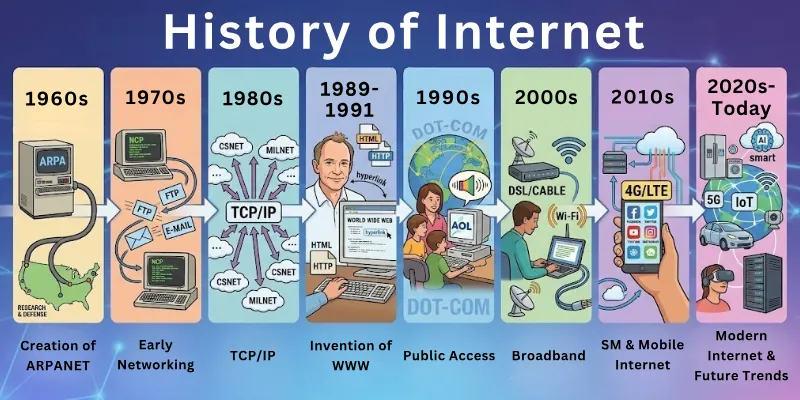
From sending simple messages to streaming videos and connecting smart devices, the journey of the internet is fascinating. Its history helps us see how far we’ve come and what possibilities lie ahead.
Key milestones in internet history:
- Early Research Networks (1960s-1970s): The internet began as ARPANET, a project funded by the U.S. Department of Defense to link computers at universities and research centers. This network allowed researchers to share data and communicate electronically for the first time.
- Introduction of TCP/IP (1980s): TCP/IP protocols standardized communication between different networks. This breakthrough made it possible for various computer systems to connect, forming the foundation of the modern internet.
- The Rise of the World Wide Web (1990s): Tim Berners-Lee developed the World Wide Web, making it easy to access information using web browsers. This innovation turned the internet from a tool for researchers into something people could use at home and work.
- Broadband and Faster Connections (2000s): High-speed internet became widely available, replacing slow dial-up connections. Faster networks allowed videos, music, and online games to reach more people.
- Mobile Internet and Smartphones (2010s): Smartphones and mobile networks brought the internet into everyone’s pocket. People could browse, shop, and communicate from anywhere in the world.
- The Internet Today (2020s and Beyond): The internet now connects homes, businesses, and devices worldwide. IoT, streaming services, and cloud computing continue to expand how we live, work, and interact online.
What is the Future of the Internet?
The future of the global internet is about how it will grow and change in the coming years. It will become faster, smarter, and more helpful in everyday life. From homes and cars to cities and workplaces, the internet will connect everything around us.
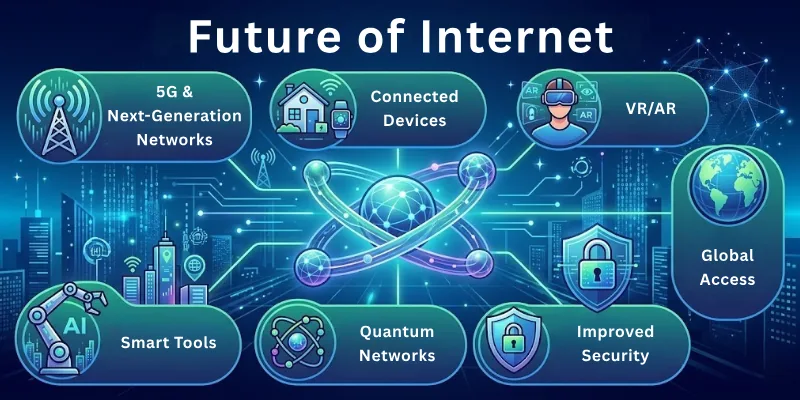
New technologies like artificial intelligence and advanced networks will make life easier, quicker, and more secure. The internet will also create new opportunities for innovation and global collaboration like never before.
- Smarter Connections: The internet will understand your needs and help you faster. Websites may load before you even click them, and smart assistants will solve problems instantly.
- Connected Everything: Not just phones and computers, but homes, cars, machines, and entire cities will work through the internet. Daily life will become more integrated and efficient.
- Faster Networks: 5G and future networks will make video calls smoother, gaming lag-free, and information instantly available.
- Artificial Intelligence: AI will make online systems smarter, predict your needs, and provide quicker solutions.
- Enhanced Security: User data and privacy will be protected better than ever, making the internet safer for everyone.
- Part of Daily Life: The internet will no longer be just a tool. It will become a central part of life, making everything faster, easier, and more connected.
Technologies Transforming the Internet’s Future
The internet of the future depends on powerful new technologies. These technologies are making the internet faster, smarter, and more useful. They will influence how information flows across the world.
New tools will create opportunities for innovation in every field. The digital landscape will expand, connecting more people and devices globally.
Let’s look at the most important ones:
1. Artificial Intelligence (AI)
Artificial Intelligence, or AI, is one of the biggest parts of the future internet. It helps machines think and learn like humans. In simple words, AI makes the internet smart. It understands your behavior and gives better results.
For example, when you search on Google or watch videos, AI suggests what you may like next. In the future, AI will improve customer support, online shopping, and even healthcare. Chatbots will answer questions instantly, and smart systems will solve problems faster.
2. 5G and Faster Connectivity
Speed is very important for the internet. This is where 5G comes in. It is much faster than current internet speeds. With 5G, you can download movies in seconds and enjoy smooth video calls without lag.
Online gaming will become faster and more real-time. In the future, faster connectivity will support smart devices and new technologies. It will make everything quick and seamless.
3. Internet of Things (IoT)
The Internet of Things means connecting everyday devices to the internet. These devices can send and receive data. For example, smart TVs, smart fridges, and smart lights are part of IoT. You can control them using your phone.
In the future, IoT will create smart homes and smart cities. Your home may adjust temperature automatically, and traffic systems may reduce jams using real-time data.
4. Blockchain Technology
Blockchain is a technology that keeps data safe and secure. It stores information in a way that is hard to change or hack. It is mainly used in digital payments and cryptocurrencies. But its use is growing fast.
In the future, blockchain will improve online security, protect personal data, and make transactions more transparent. This will build trust on the internet.
5. Cloud Computing
Cloud computing means storing data and running apps on the internet instead of your device. For example, when you use Google Drive or Dropbox, your files are stored online, not on your computer.
In the future, cloud computing will make work easier. You can access your data from anywhere. It will also help businesses grow faster and manage data easily.
How the Future Internet Will Change Life
The next-generation internet will change the way we live, work, and interact every day. It will make life faster, smarter, and more connected. Homes, workplaces, schools, and healthcare systems will all benefit from smart technology powered by the internet. Daily tasks will become easier, and people will save time while staying connected.
Let’s explore how the internet will shape different aspects of our lives.
1. Smarter Homes
The internet will make homes more responsive and connected. Smart systems will adjust automatically to your habits and needs. By 2026, over 60% of homes in developed countries will use smart devices connected to the internet.
- Control lights, fans, and security systems with your phone
- Your AC can turn on automatically before you reach home
- Smart devices save time and energy
- Every day tasks become easier and more convenient
2. Work Life Transformation
Workplaces will evolve with better connectivity and smarter online tools. People will collaborate seamlessly across locations. Over the next few years, remote work is expected to account for over 40% of professional jobs worldwide.
- More people will work from home using fast internet
- Online meetings will have better video quality with no delays
- Collaboration with teams across countries will be seamless
- Smart tools will make work more productive and flexible
3. Future of Education
Education will adapt to the needs of each student, making learning more interactive. Digital tools will support creativity and personalized lessons. Over 70% of higher education courses will include online and VR-based learning tools.
- Students can attend classes online from anywhere
- Smart tools, videos, and virtual reality will enhance learning
- Lessons will become more interactive and fun
- Education will adapt to students’ needs and pace
4. Improved Healthcare
Healthcare services will become faster and more connected, allowing people to manage their health easily. Data from devices will help doctors provide timely care. Wearable health devices will monitor vital signs for over 50% of patients in developed countries.
- Online consultations with doctors will become common
- Smart devices track health and send real-time reports to doctors
- People will get advice without visiting clinics
- Healthcare will become faster, more efficient, and more convenient
5. Better Shopping & Entertainment
The internet will make shopping and entertainment more personalized and accessible. Smart platforms will understand your preferences. Online shopping is expected to account for over 25% of total retail sales globally.
- Online stores will suggest products based on your needs
- Streaming movies and games will be faster with no buffering
- Entertainment will be more personalized
- Shopping and leisure will become easier and more enjoyable
6. Everyday Life Integration
The internet will blend into daily life seamlessly, connecting devices, tasks, and people without interruptions. Life will become more coordinated and convenient. Nearly all daily appliances and devices will connect to the internet for seamless control and automation.
- The internet will be part of daily life everywhere
- It will help people save time, stay connected, and live comfortably
- Smart technology will make homes, work, and leisure more efficient
- Life will feel faster, easier, and more connected than ever before
Future Trends in the Internet
The internet is moving into a new era that will touch every aspect of daily life. Technology will become more adaptive, responsive, and seamlessly integrated into routines. Innovations will open doors to creative solutions, smarter tools, and faster services.
The next generation of the internet promises to change the way we connect, communicate, and live. Life will become more efficient, intuitive, and enjoyable.
Here are the top future internet trends you should watch:
1. Metaverse (Virtual World)
The metaverse is a digital universe where people interact using avatars. It will create immersive spaces for work, play, and social life. Businesses and creators will develop experiences that feel like reality.
- Attend virtual meetings with coworkers worldwide instantly
- Play multiplayer games inside immersive 3D environments
- Explore online marketplaces using avatars comfortably
- Socialize with friends in interactive virtual spaces
2. Virtual Reality (VR) and Augmented Reality (AR)
VR and AR will change how we experience learning, work, and entertainment. VR transports you entirely to a digital world, while AR adds virtual layers to reality. These technologies will make online interaction more practical and engaging.
- Try clothes virtually before purchasing online
- Explore historical sites through augmented overlays
- Attend interactive online training sessions effectively
- Experience concerts and events digitally from home
3. Smart Cities
Future cities will integrate internet-connected systems to improve urban life. Traffic, energy, and safety systems will adjust automatically using collected data. Residents will experience efficiency, convenience, and safer environments daily.
- Optimize traffic flow using connected traffic sensors
- Monitor air quality across neighborhoods continuously
- Automate street lighting for energy efficiency
- Provide emergency alerts with real-time notifications
4. Automation and Smart Systems
Automation will reduce human effort in daily and professional tasks. Machines and intelligent software will manage repetitive or complex work efficiently. This will increase productivity and convenience in multiple sectors.
- Automate customer service with intelligent AI bots
- Schedule household tasks using smart home devices
- Monitor manufacturing lines with automated systems
- Control office equipment remotely with smart software
5. Edge Computing
Edge computing processes data near its source to reduce delays. It will improve speed, reliability, and responsiveness for connected devices. Applications like gaming, streaming, and IoT will benefit greatly.
- Reduce latency for faster online gaming experiences
- Enable real-time analytics on industrial machinery
- Stream high-resolution video without buffering issues
- Improve the performance of smart home appliances
6. Stronger Cybersecurity
As online activity grows, protecting data becomes essential for everyone. Future cybersecurity systems will prevent breaches and secure sensitive information. Users will enjoy safer, more reliable internet experiences.
- Detect cyber threats using AI-based systems
- Encrypt personal and business data automatically
- Monitor networks continuously for suspicious activities
- Protect financial transactions from unauthorized access
Benefits of the Future of the Internet
The advanced internet future will bring many benefits to our lives. It will make things faster, easier, and more convenient for everyone.
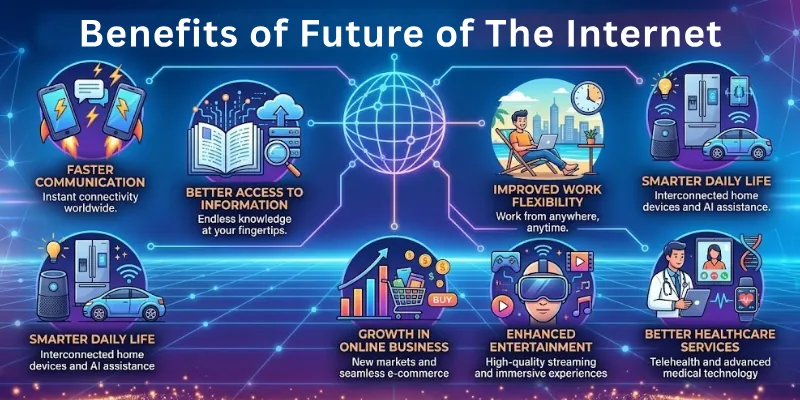
Here are the key benefits:
- Faster Communication: You can connect with anyone in seconds. Video calls and messages will be smooth and instant.
- Better Access to Information: You will find any information quickly. Learning and research will become easier for students and professionals.
- Improved Work Flexibility: People can work from anywhere. Remote jobs will increase, and work will become more flexible.
- Smarter Daily Life: Smart homes and devices will save time. Daily tasks will become automatic and easy.
- Growth in Online Business: Businesses can reach more customers online. Selling and marketing will become more effective.
- Enhanced Entertainment: Streaming, gaming, and online content will be faster and more enjoyable without delays.
- Better Healthcare Services: Online doctor consultations and health tracking will improve medical care.
The Future of the Global Internet: Challenges
Tomorrow’s internet will bring many benefits, but it will also create some challenges. It is important to understand these issues so we can use the internet safely and wisely.
Here are the key challenges:
- Privacy Issues: More data will be shared online. This can risk personal information if not protected properly.
- Cybersecurity Threats: As the internet grows, hacking and cyber attacks may increase. Strong security systems will be needed.
- Fake Information (Misinformation): False news and wrong information can spread quickly. This can confuse users and create problems.
- Digital Divide: Not everyone will have equal access to fast internet. Some areas may still face slow or limited connectivity.
- Over-Dependence on Technology: People may rely too much on the internet. This can affect real-life communication and skills.
- Job Displacement Due to Automation: Machines and AI may replace some jobs. This can create challenges for workers.
- Data Overload: Too much information online can make it hard to find what is useful and true.
Expert Predictions About the Internet Future
Experts predict that the future internet will be smarter, faster, and deeply connected to our daily lives. It will transform how we live, work, learn, and communicate. Leading organizations like the World Economic Forum and Forbes highlight advancements in AI, virtual reality, and high-speed networks. The internet will not just be a tool but an essential part of everyday life.
Let’s explore what experts expect in the years ahead.
1. Smarter Internet with AI
The internet will anticipate needs and deliver services that match user expectations. Online platforms will learn patterns and adjust how information is presented.
- Platforms will understand user needs and provide faster, more accurate results
- Artificial intelligence will make online systems more intelligent
- Tasks like searching, shopping, and learning will become easier
- Technology will adapt to users instead of users adapting to it
2. Connected World
Devices and systems across homes, offices, and cities will link seamlessly. This connectivity will make urban management and personal life smoother.
- Not just smartphones and computers, but homes, cars, and cities will connect online
- Internet systems will control appliances, traffic, and public services
- Daily life will become more automated and efficient
- Everything around us will work through smart internet systems
3. Rise of Virtual Experiences
People will spend more time in immersive digital environments for work, learning, and leisure. These experiences will feel closer to reality than traditional screens.
- Virtual reality will let people work, shop, and communicate digitally
- Online experiences will feel immersive instead of just on screens
- People will attend meetings, classes, and social events virtually
- Digital environments will enhance convenience and engagement
4. Focus on Data Privacy and Security
As more data moves online, keeping it safe will become a top priority. Companies will adopt stronger systems, and users will gain more control over personal information.
- Companies will build stronger systems to protect personal information
- Users will share more data safely online
- Security measures will grow alongside the digital economy
- Trust and privacy will become central to internet use
5. Remote Work and Digital Economy Growth
The workplace will be flexible, letting people work from almost anywhere. Businesses will reach global markets, and online collaboration will become the norm.
- More people will work from anywhere using high-speed internet
- Businesses will reach global audiences without physical offices
- Online collaboration tools will become standard in workplaces
- The digital economy will expand opportunities for individuals and companies
6. Faster and More Reliable Networks
Internet connections will become quicker and more dependable. This will support heavy data use and real-time online activities.
- Future networks will provide high-speed connections with minimal delay
- Streaming, gaming, and online meetings will run smoothly
- People will experience more seamless online interactions
- Reliable connections will support smarter homes, work, and entertainment
7. What’s Next for the Internet
The internet will touch all parts of life, connecting people, systems, and services. Experts expect this transformation to improve efficiency and convenience globally.
- Technology will improve and reshape everyday life
- Experts predict smarter, safer, and more connected systems
- Work, education, healthcare, and leisure will all change
- Life will become faster, easier, and more integrated through the internet
Conclusion
In our discussion, we covered the future of the internet and how it will change daily life. From technologies shaping the future to smart cities, VR/AR, automation, and connected devices, we saw how faster, smarter, and more reliable systems will affect work, learning, and entertainment. While these innovations bring amazing benefits, challenges like privacy, cybersecurity, and misinformation must be managed carefully.
I recommend using these technologies responsibly, staying aware of risks, and adopting safe online habits. I hope this guide gave you clear insights into the internet world ahead.
Check the next FAQs; you may learn more that could save time and effort in your digital life.
Frequently Asked Questions (FAQs)
Here are the top questions people ask about the next internet evolution.
The digital future of the internet will be faster, smarter, and more connected. It will seamlessly link homes, cars, cities, and workplaces. Artificial intelligence and advanced networks will make online experiences easier and more efficient.
AI will make the internet more intelligent and personalized. It will understand user needs and provide faster, accurate solutions. Virtual assistants and smart tools will predict what you want before you even ask.
Yes, new technologies like 5G will provide ultra-fast internet. Streaming, gaming, and video calls will be seamless with minimal delays. High-speed internet will also support smarter homes, businesses, and advanced technologies like virtual reality, cloud computing, and AI applications.
Yes, cybersecurity and data privacy will improve significantly. Advanced systems and AI-powered tools will help protect user data, detect threats, and prevent attacks, making online experiences safer for both individuals and businesses.
Virtual reality will create immersive experiences for work, education, and entertainment. People can meet, learn, and shop in digital environments. It will make online activities feel more real and interactive.
Yes, the future internet will connect everything from cars to wearable devices. This is known as the Internet of Things (IoT). It will make life more integrated and efficient. These connected devices will also communicate with each other to automate routines, like sending alerts when something needs attention.
5G and beyond will provide extremely fast and reliable internet connections. Streaming, gaming, and online work will happen without lag. It will also support smarter cities and advanced technologies. These networks will make communication and remote work much faster than before.
Access to the future internet is expected to become more widespread. Global satellite networks and faster, more affordable connections will help reduce the digital divide. As a result, more people will gain access to education, jobs, and essential services online.
Wearables like smartwatches and fitness trackers will be more connected than ever. They will monitor health, activity, and even stress in real time. Data will sync automatically with apps to provide useful insights instantly.
Chatbots will become smarter and provide instant, human-like assistance. They will handle tasks like booking, customer service, and problem-solving automatically. Businesses and users will save time with faster responses. They will also remember your previous questions and preferences to give more accurate and personalized answers each time.


- Be Respectful
- Stay Relevant
- Stay Positive
- True Feedback
- Encourage Discussion
- Avoid Spamming
- No Fake News
- Don't Copy-Paste
- No Personal Attacks
- Be Respectful
- Stay Relevant
- Stay Positive
- True Feedback
- Encourage Discussion
- Avoid Spamming
- No Fake News
- Don't Copy-Paste
- No Personal Attacks
